OK, I just installed the latest Ubuntu 10.4 aka Lucid Lynx. Well it needs tweak'in and I just gotten to like the "Human" colors on Ubuntu 9.04-9.10. I was down with brown and being a brown guy myself, was groov'in on all things brown from rich Corinthian leather to chocolate bars. This purple haze thing is.........well good thing change is good.
Well, Ubuntu 10.4 is as fine as can be expected, boots a little faster, shuts down a lot faster. In between it is just Ubuntu which is very cool. But that Gnome Shell which I admired and enjoyed in the previous version does not work for me on my PC in this version. I am so disappointed, what a let down. Gnome Shell was very cool, yet needing some revising. I would have used it as is. It is coming but we will have to wait. Stay tuned for the sequel folks.
Why change? First of all let me say that change in Linux is normal, whether it is comfortable or not depends on how much work you have to do. This 10.4 version is what they call "LTS", which I think means Long Term Stable. Meaning it is the stable base from which minor upgrades will come until the next "LTS" version down the road. If you don't need to upgrade every whenever, you can just do it when the next "LTS" comes out and still be cool.
How do you prepare for change? Being a former Microsoft guy, now a Linux guy I think it is crazy to have one hard drive on a PC. With the advent of the thumb drive and the USB external drive, I think it is wise to put your personal files on a different drive than with the operating system and applications. This is very convenient for when your system crashes, the operating system gets hosed, you want to upgrade or you want to change. If you put your stuff on an external drive you don't have to back them up, just remove the USB and plug into another PC. Now if files are suspect you can remove them from the infected PC and scan them on a good one, and repair the OS separately or reinstall it.
For this change I bought two small thumb drives 2 gig each. I will eventually get a 4 or 8 gig for this file moving business. They are also handy for putting a boot-able OS on them, so cool. If you want a bigger thumb drive, the larger USB portable drives are better priced and bigger. I was at Best Buy the other day, a 1TB hard drive, that's one terabyte or 1000 gigs for $109.99 on sale!?! If your OS, apps and movie collection all on that thing gets lost because the OS crashes badly or you have to back up that big.......... sometimes even partitioning won't save you.
Now the question comes up, do penguins shed? Just like the guy with the bag on his head, you rip off the bag to find another bag. Oh, the other question, how do you like this new Ubuntu 10.04? It works fine, perhaps better, but the art work doesn't have the zest of the previous versions. I think we sometimes strain to be fresh and different. In the end a group of folks are trying to please the masses, which means the best part of Linux is that you can still change it to suit yourself.
Friday, April 30, 2010


Thursday, April 29, 2010
job hunting geeks and HR filters
Ever wonder why they call it "state of the art" and not "state of the science"?
While you're pondering, my realization is that I have been a computer user for a good number of years, and through that time I have become mildly obsessed. I didn't learn machine code, or Basic or scripting or wire wrapping circuit boards by hand. I have known ones who could boast in those skills. I'm just a button pusher fascinated by what happens when all the software and hardware are in place and you click the button, wow!
If you put this here and that there, does that work? What if you tried this or used that in a different context? My favorite is update older concepts, repackage them, use them in the present context. Why, because there are sweet-spots where everything seems to fit and work just right. A lot of times products off the shelf miss that sweet-spot. There are all kinds of different users so the sweet-spots are different. We all settle for what's close enough. Sometimes we are psyched into stuff because the advertising has brainwashed us. We complain because it ain't "sweet."
You find that level of computing you can understand, then the science becomes art. I had a friend, M. Booker. He had a dream job, at least to me. He worked for DEC Equipment in the heyday of the mainframe. He put them together and made them work. That was a job. Man, I envied him and marveled at his stories. M. Booker is a tad younger than I yet he was into computing way before me. Some get that chance to grow up with computers, that's why they are gurus and geeks. It's not weird, it's the same for auto enthusiast we call grease-monkeys, gear-heads and lead-foots.
My world is so strange, the people around me are so into stuff. They try to pull you their way or push you another. Where you are at does not appear viable to them. I am talking as an unemployed person taking jobs as they come and advice. There are sweet-spots with jobs too. Most often there is sacrifice because the focus of the job and the energies spent are not always your ideal. But you do what you need to do to support yourself and family, even putting aside the sweet-spot. You flex and adapt and apply yourself at work, then at home you tinker, dabble and dream.
Going through school, getting a job according to that training, having a career, that is science. When life doesn't flow this straight or this smoothly it becomes an art. I do not know all I am capable of, I just know I have a habit of applying myself. I do not know everything up front and total recall or regurgitation of industry standards is not proof of ability. Experience is time spent in a focus. When companies insist on experience, they are not interested in your capacity to learn or your ability to apply yourself. They're not interested in are you familiar enough, they ask do you know it? Yes or No? Do you know the science?
They insist on science, but it is really an art? Especially with computers, every area is so broad. You have to go against what you feel is the realized truth to sell yourself, "Yes, I know it." Then they demand proof and spit out hypothetical situations to which you are to supply real typical solutions. "We want the science." I am an artist, won't really know till my hands are on it. When I am seeing the real problem and I am engaged in the process, then all my resources and energies and knowledge converge, I am blank and stumbling when you ask me now. My job is to get a job, not work the job! It's a different focus."
Some HR folks set the Rubic's cube in front of you and say fix it. They expect you to have autistic focus, as if they are not there, instantly grabbing the cube without emotion. Then expect a furry of twisting and flipping without bending the elbow. Ok Mr. Johnson, you can almost do it but you took longer than the industry standard. Can you explain? Yes, Mr. HR, most of my experience of late is in trying to get a job, not actually working a job. Job seeking erodes and diminishes my technical skills by diverting my energies to skills I don't need when I have the job. Over time I wonder what's wrong with my job seeking skills and dump more time into that rather than keeping my job skills sharp. Then, every job I apply for in IT is asking for something a little different and they want experience. I can't know it all and you don't offer on the job training these days.
Meanwhile, back at the Linuxville guide office, lab and center for job search and part-time decompression chamber, life with Linux goes on.
Often I am downloading and running Linux live-CDs to see how well they run on my assortment of equipment. I fuss with ideas I learned in school or read somewhere or dreamed of. And I fix stuff of friends, most of whom only know Microsoft and never heard of Linux. They ask for Microsoft advice and wonder what kind of geek are you if you aren't a Microsoft expert? I'm a stranger in a foreign land, yes, but also being a desktop Linux enthusiast I am not too cool with the Linux server crowd. Some think the desktop is a dumbing down, I say I use a cup instead of a bucket, still I drink, same Linux, smaller portion.
Monday, April 26, 2010
coming to terms at last
My second machine has been acting strange ever since the hard drive bellied up. The new drive, a Maxtor 10 gig, is fussy, but then so are the two CD Rom drives that have to cipher disks. Older PCs are much like older cars, reliable when they run, but wear and tear show at odd times.
Xubuntu didn't do so good. So I whipped out my copy of #!Crunchbang. It sliced through my hardware like a clean knife and is a fast install as I ever seen. Crunchbang is Ubuntu based but has Openbox window manager. It is lean and mean with a stark black screen and white letters. You have to tweak it to make the colors come out but you don't want to spoil it. As my second machine I don't need it to do heavy lifting so I'm using it for doc storage and to play back video tutorials.
Oh yeah, Conky is on deck with this distro with it's on screen system monitor and a listing of keyboard shortcuts to make learning them a breeze. All it need now is Synergy to share keyboard and mouse.
I sense a GNU-vana moment approaching. It's an endless cycle upgrade, then learn new stuff, then make it better again, then fix when it brakes, then............If I had new stuff I would be bored, Linux just works, gives me nothing to do, so I tinker.
Now that was strange!
Ok, I gave it a fair shot and I like it but........
Wonderful thing about having two computers, you get to compare operating systems side by side. If you are immediately drawn to one or the other, you find out.
On the right, the home boy, Ubuntu Linux 9.10, sporting the preview version of the Gnome Shell. On the left various challengers including XP (he gets few calls these days).
Just installed a second drive on this second PC so fresh installs are the way to go. Xubuntu is first, I installed it and the little window size buttons and header bars did not appear or work. Gee, it worked before on this machine. The live-CD runs OK and I am moving windows around, but compared to the Gnome Shell it is extra work to get to stuff. Then another live-CD, Elive 2.0. This OS is a drooler, it is so good looking. Elive has compositing charm but no compositing. This means you can still run it on a low resource machine and get good performance. But wait, darn, I have a warning window that says ATI video cards are known to cause problems with certain drivers and may crash the system. It works but missing icons and quirky actions, drat that ATI. We'll have to try another video card and see how it goes. Elive 2.0 is still racing after the Mac type desktop but has the Linux toys, compared to Gnome Shell?
The Gnome Shell just sits there working with almost no effort (fewer mouse clicks). I don't have to set up shortcut icons and application launchers. I think the work flow is a little smoother. The big shock is accepting how it's setup, you know how Linux users are fiercely resistant to being told what to do and how to do it. The good thing is that so many other desktops exist. I hope if the Gnome Shell becomes the standard, that the windowing desktop folks are use to is not thrown away. Then you can put regular or decaf in the session selector when you log in.
What's strange is I like the Gnome Shell over the what we all are used to in windowed desktops. It reminds me of Konqueror, the file manager/browser/viewer that could do so much and was under appreciated, basically the only thing I liked about KDE. And also a little bit of Matisse desktop, which was mostly in Mandriva Linux. To me, this is what a PC is all about the file manager. Having access to my files is the most important thing, then the program menus. So how to get there has to be short with fewer distractions. I didn't like compositing because you had to "find" a working setup yourself.
Linux is wonderful with all the choice, but the selfish arrogance of some vocal users hampers wider acceptance. A better solution would be configuration recipes posted that other users could immediately appropriate. This way the folks with simple needs can better find their way and the boasters can still show off with gusto. Science is about repeatable results, not just being the first and the most extreme. Community is about forging the way for others also, else wise you are adrift on your own iceberg (global warming anyone?).
There is the glitz of all kinds or screen manipulation, multi-touch, immersion 3D........... then there is making present technology and user habits more efficient by changing the beginning premise. You can do this in Linux. KDE almost did this and you have to like the way they made it customizable. But KDE is too fidgety. Everytime the cursor passes over something there is possibility for unwanted change. Gnome Shell is more static feels more stable. When I click, I know what to expect. I found the same thing when comparing KDE's BasKet Note Pads to KeepNote. They both allow text and pictures, but BasKet Note Pads requires care because things move and float. So a program can run stable, but is it stable in the user's hands. If the program feels sure in the user's hand, they have confidence to use it more often.
Gnome Shell is cool but make it a standard "option".
Sunday, April 25, 2010
Gee, that was fun, lets do that again!
Here am I doing my blog thang,
 Nothing new here, but let me zoom out some:
 Lookie there! What is that? It's called the Gnome-shell and it is as snazzy as snazzy can be. It's going to be in the newest coming Ubuntu with the Gnome desktop and it's a turn-around from the regular windowed desktop we love and loath. It's handy for me because all the windows we are used too are working me to death. While I liked the icon bar and the kind of Mac OS look this is more better, more functional for me. And you thought that flashy new Win7 was something, puh!
I won't spoil the fun for you, these are all the pics you'll get from me. You'll have to search for the previews your self. But if you can't wait, like me, I found it in the repositories via Synaptic. Now the standard warnings apply, read the home page and learn what you can do with it, how to start and stop it and take it for a spin.
Why am I impressed? Because the last two years we've been caught up in an eye-candy flurry called compositing. Gee, how much power does it take to do that? Lots of memory and a graphics card with muscles and oh wait I see the Enlightenment desktop beautifully doing fancy desktop effects and it's fast and efficient, without compositing. Too much of anything is mind numbing. The Gnome-shell gives me a cool way to approach my files without layers of configs and shortcuts. I like the way it guides you to use all those workspaces Linux is famous for. Even I got that MS Windows habit of putting stacks of open windows on one desktop. Man, I feel like my hands were untied.
So, a tip of the ole penguin flipper to you Gnome-shell developers, you did good.
Saturday, April 24, 2010
It was an inside job.
Well my LCD monitor de-rezzed for the last time, I whispered to myself', "I need to take it apart to see what's wrong". There was a loud out cry, "No disassembly!?!, Johnny 5 is alive!!!"
A technician gets no respect in his own lab. I called the maker (HP), they grilled me according to their script. I kept telling them I am a certified technician, but they had to make sure I was grilled on both sides. Finally I got agreement that my LCD monitor was faulty. Then I proceeded to ask about the two circuit boards on the inside. The power board seemed OK but I wasn't getting a picture so I suspected the video board. Oh man, I could hear them thinking, "red alert, red alert, the user opened the case!" I asked the question simply, "Is it possible to purchase a new video control board for my LCD monitor?" It is a yes or no question, right? They insisted I just buy a new monitor. Dudes, that's very not green of you. Two or three emails later I got the "no way" response.
Come on, I am not talking about fixing a broken board, just swapping an old board with a working replacement. I have faced this in other areas like oven and washing machine repairs. There are certain consumer level repairs and then stuff so technologically complex and life threatening a credentialed specialist is required just to get the parts. The install is simple but you must understand the whole system so that if something goes wrong you know what to do. Gad, I'm so strained I need to degauss myself.
Taking the monitor apart I find the numbers and search the net. You know, it's cheaper to just find the same but used LCD monitor on ebay than find parts to fix the one I got. God forbid I learn something to keep what I own working. So I recycle the old monitor and they either trash it or test and reuse and swap out the parts. Gee, I can do that!
A techie gets no respect in his own lab!
Speaking of labs, I cleaned out my bookshelf, looks barren now. I got rid of old Win95, NT, Autocad 11, Office 95 books and others. The old Linux stuff I kept, lots of it still applies even though todays Linux is ten times better. I think that is a truism that MS totally changes to improve. Linux gets better but is essentially the same. It's the modular design of course. I can even get an up-to-date Linux with an older GUI if I wanted to retro. Right from the beginning Linux info was posted on the net. And that is where you will find it today. So the drive for eReaders for digital books and documents will well serve the Linux community. And that's a wrap for today, eWord up!
Tuesday, April 20, 2010
The candy shop and deep dabble
Man, I've been to the candy shop. It's called "DC Parts". It is wonderful though not as when I first went there years ago. Oh yeah, it's a computer parts store. It was like the old 5 and 10 with every nut and screw and clip and cable you ever saw. It is still a great place but today their inventory is trimmed a little. They got used PCs and laptops. I went today and got a 40 gig hard drive, some powered speakers, a USB cable and an audio cable. I had to leave quick, my wallet was empty and my eyes getting bigger. Man, that was a blast.
Well, the hard drive was a bust, so I went back a few times and three drives later got one that my bios could see. With used equipment, milage may vary. Good thing they exchanged it for nothing. Today I am so pleased, it works and I installed Xubuntu 9.10 on it. The PC has a second drive with XP on it.
I guess I can call my computer desks a lab. I am always trying to move things into a more workable arrangement. My LCD monitor bombed out. The lower half had a yellow haze, the screen image was wavy like water, then the picture would go black after a few minutes, but I still had power. I set it aside, then opened it thinking the capacitors had burnt. I took the whole thing apart, put it back together. World of wonders, it works OK now. I really didn't do anything but it now works! How long? I think when I am not sitting in front of it I might turn it off, just to be cautious.
So this all works out fine. My main PC has the big CRT which is fine as the higher resolution is great for graphics. My second PC has the LCD display which is very clear. And I now have powered speakers for both PCs. One little thing I did, since my second PC has no front USB ports, I bought an extension cable. It is very awkward to reach under the desk and around the back of the PC to access a USB port. The extension cable puts the port on my desktop.
I am thinking of re-installing Synergy so that I only need one keyboard and mouse to use both PCs. Two keyboards and two mice on one limited desk surface is near impossible. I've typed stuff on the wrong keyboard into the wrong PC, funny but not fun.
Perhaps I need a server, that way I can store stuff in one location and not worry on which PC it's hiding on. You see this is what's so great about Linux and Open Source. You can move things around, change stuff and not fuss with activations and authentications and putting your paid for copy on more than one machine reprisals.
I am not a guru and not a noobe, yet through deep dabbling I have achieved Gnu-vana.

Wednesday, April 14, 2010
eh, that's a flower!?!
I have been working away trying to comprehend the splender of Blender 3D.
First let me say that surveying the landscape of Linuxville is a great thing, but........ you usually wind up with one of two things. The Linux Bazaar, hey look at this , look at that, try this, do that. OR deep in the darkest part of the network jungle, there lurks a circle of very hot servers cooking this Linux code and that code. Well, since I am a Linux user and a "personal" system admin instead of a corporate one, I want to show you what I brought home from the venerable Linux Bazaar. Why, because the applications are the whole mystery of Linux on the desktop. Folks rave about the Linux OS, you get the picture you can't do anything but server work. Let me tell you, servers don't need a GUI, or pretty wallpaper and you the average desktop user doooo! Even hardened text terminal gurus will have a desktop PC near by to have and behold a graphic file once in a while.
Also your personal activities are as valid to you as the data being managed in a corporate setting. That's what makes Linux so wonderful and it's called scalability. That's both to fit the range of hardware and also the range of user purpose.
My thing is digital art, not for some commercial venture (at least not yet) but for personal learning, personal adventure and experimenting. I will add that with Linux and Free Open Source Software (FOSS) you can not only start something with low or no cost, you can alter the code (if you have the skills) with no reprisals or legal harassment.
I started Blender 3D after years of hearing how hard it was to learn. What button do I push first? The secret is the bread crumbs left by ones who been there. Get the tutorial videos, play them till they make sense, the logic is subliminal, not apparent right off. While using it, it becomes clearer.
Here's what I am working on:
 So far I learned to rearrange the windows, some basic keyboard shortcuts, what different commands and windows do. I am learning the feel of manipulating the cursor and scene, making and placing objects. What is that? That is what I call the Sunflower Dome Haus. Remember the cargo container home thing? Imagine 10 small cargo containers in circle the wagon style, then cover the middle with a dome. The space inside would be wonderful. And this is my other point, you can play with some ideas better if you can illustrate them. In 3D this is mind boggling and exciting. You may not build it in your backyard but on your PC, hummmmmm!
How does this compare with CAD drawing? 3D modeling may or may not be as precise as CAD but is definitely more efficient in working with concepts. Once you "get the picture" the details are easy. I tried Google's SketchUp, it is cool but no Linux version, that is sick. Ah, the road less traveled.
The other thing is weird. Once you start really using a Linux application, it seems you are all by yourself, everybody else is using some MS platform app. You need to peruse the Linuxville neighborhood and find some companions in the same pasture. Yes Martha there are warm weather penguins. They are the Birds in Black. They wear shades and make a PC look good!
First let me say that surveying the landscape of Linuxville is a great thing, but........ you usually wind up with one of two things. The Linux Bazaar, hey look at this , look at that, try this, do that. OR deep in the darkest part of the network jungle, there lurks a circle of very hot servers cooking this Linux code and that code. Well, since I am a Linux user and a "personal" system admin instead of a corporate one, I want to show you what I brought home from the venerable Linux Bazaar. Why, because the applications are the whole mystery of Linux on the desktop. Folks rave about the Linux OS, you get the picture you can't do anything but server work. Let me tell you, servers don't need a GUI, or pretty wallpaper and you the average desktop user doooo! Even hardened text terminal gurus will have a desktop PC near by to have and behold a graphic file once in a while.
Also your personal activities are as valid to you as the data being managed in a corporate setting. That's what makes Linux so wonderful and it's called scalability. That's both to fit the range of hardware and also the range of user purpose.
My thing is digital art, not for some commercial venture (at least not yet) but for personal learning, personal adventure and experimenting. I will add that with Linux and Free Open Source Software (FOSS) you can not only start something with low or no cost, you can alter the code (if you have the skills) with no reprisals or legal harassment.
I started Blender 3D after years of hearing how hard it was to learn. What button do I push first? The secret is the bread crumbs left by ones who been there. Get the tutorial videos, play them till they make sense, the logic is subliminal, not apparent right off. While using it, it becomes clearer.
Here's what I am working on:

How does this compare with CAD drawing? 3D modeling may or may not be as precise as CAD but is definitely more efficient in working with concepts. Once you "get the picture" the details are easy. I tried Google's SketchUp, it is cool but no Linux version, that is sick. Ah, the road less traveled.
The other thing is weird. Once you start really using a Linux application, it seems you are all by yourself, everybody else is using some MS platform app. You need to peruse the Linuxville neighborhood and find some companions in the same pasture. Yes Martha there are warm weather penguins. They are the Birds in Black. They wear shades and make a PC look good!
Friday, April 09, 2010
careful wid that nose
Now that I stuck my nose in the flower and got stung, I have to explain it to everyone who ask the obvious. They always ask how but not why, except for smart-alicks. Don't use the medical jargan, say "man what a rush!"
You see the flower in this case is Blender 3D and the bee is its user interface. It is repeated that the Blender interface is difficult and hard and has a steep learning curb (a pain, it stings). But once you nose around you will get zapped, marked for life as it were, a Blenderhead.
To the casual observer the interface resembles a Borg spaceship, this is why the reports are out there. Don't stick your nose in there! Thankfully there are video tutorials that take the mystery out of Blender, oh! you will get stung! But if you don't get the basics down your nose will look like a red-skin potato. So my advice to would be Blenderheads, check out http://library.creativecow.net/ and click on the Blender 3D Survival Guide 1 thru 9. Paolo Cicone explains Blender via a simple animation project, you will get stung. But instead of a mass of scar tissue, you will have a red dot and that stupid smile of accomplishment.
Ok, the Batman movie where he had to climb the obscene terrain to get the blue flower, only to have it made into a disillusion powder. Or, the Snuggle bear, dancing through fields of fragrance. Believe it or not, you can do both in Blender, but you got to start somewhere.
Any good graphics application requires a right of passage, Blender is no different. You may be a hard edge know it all, able to learn it without any help. Why waste the time and energy figuring when that part has been pre-digested for you. Get the vids, learn the stuff, save your grunts for the really hard stuff, content.
Blender 3D comes in 4 flavors, Linux, Mac, BSD, and Microsoft, because it is Open Source. There is abundant documentations, tutorials, videos, artwork and finished products as in movie effects, cartoons and stills. You can make models, import models and...........
Also notice that on the Creative Cow site the other application vids that are there. But I advise Blend first unless you got stuck in those other fields.
So, this is the Linuxville guide dude, buzzing off to render in the splender of Blender. And don't forget to visit http://linuxgraphicsusers.com/forum/
for tips, help, chat, boasting and bragging and critique.
Wednesday, April 07, 2010
smelling the flowers risks a bee stung nose
I walk past them every day, the flowers.
every color calls to me, every form.
I take pictures and sketch them, I invent new ones,
the ideas come so fast and I can see them printed on everything.
Then I get mad, I can't do them justice, I can't capture what I see.
I don't really do flowers but in order to do them I must bend over and stick my nose into one flower.
It's my personal dilemma, having art in me but not spending the time on the means of expression. I have surveyed many art softwares and fumbled with my digital pen and pad. It is now time to commit to the art process.
You have to laugh, it is sort of like the movie Karate Kid, Mr. Miagi gets the kid to clean the house, the car and the the boy wants to kick butt. You have to train your body in a kind of language. You have to let the media train you before you can bend, stretch and alter the media. How the brush is loaded with paint, how it applied with your movements, how it feels and looks. It is the same with digital art. You learn the interface, the tools, the effects, all in an interactive "play".
The hardest thing for me is accepting that the process is slower than how I think. I just conceive the idea, record it in my sketchbook and I am done. I need to take the time to develop the idea via the process. You get a busy life, a sketchbook becomes a convenient way to keep the creative juices flowing between circumstances. It also become a pit. For an artist's main expression to be his sketchbook is not productive at all. It is not the number of ideas to fill up a sketchbook, but the completeness of each idea.
Like kids you gave birth to, now you got to raise them up. You get a great idea, you need to give it time to develop and mature with you.
To me I've always had the art viewers mind. There is a kind of excitement to roam a museum or gallery and oogle till my eyes are bloodshot. The actual work an artist does is really work the viewer doesn't appreciate. Time spent till the tools and techniques are transparent and fluid and the experimenting and risking and the great accidents and the flubs, these are mostly hidden. Well, what about performance art? Even there, a big part of the process you don't see is the prep. An artist does the process.
You got a big red nose because you stopped, bent over and stuck your nose in the flower and got stung. You smelled the aroma, got a little dust on your cheek. You looked the bee right in the eye as he buzzed madly, "don't poke your nose into my business!" You yell, then laugh, embarrassed but with a satisfying grin.The neighbors snicker, " that'll learn ya", I wouldn't have done that!", "serves ya right!".
To be an artist is to stop and actually smell the flowers everybody talks about. To be an artist is not without risk, so hold your big red nose in high esteem and open display.
Friday, April 02, 2010
making change @will
One of the things I appreciate about Linux and especially Ubuntu is the @will command. You won't find it on your keyboard, it is a mental thing. Because so many resources are either built-in or available online and or in the software repositories, you can try out stuff @will.
Let's say you want to use the terminal to start applications because you are a dyed in the wool keyboard jockey. You could pop an icon with a mouse click, search and deploy through the main menu or install "Guake Terminal". What the heck is Guake Terminal?? World of wonders man, where have you been? No, I just discovered it myself. This Guake Terminal sits invisible in the background and comes forward with one keystroke (F12). No touchy the mouse for this! Type your command, fire away and hit F12 again to send it back into it's invisibility cloak. An icon appears in the panel to let you know it's there waiting and there are tweak preferences, if you must.
Like I said the @will thing is cool. When I use Synaptic to install stuff and if not satisfied, I can gently removed them leaving behind config file residue or remove all traces. I have scrunched my changing down to here and there. A change of scenery is fine tuned with the help of Desktop Drapes. This app lets you change wallpaper from a directory by clicking on the tray icon or at a timed interval. Change is good, but not too much change. You can over do desktop dynamics to where your senses are overloaded. Excitement and adventure, a Jedi does not seek! Just think if Skywalker were sliding down the chute at Bespin and said "man I got ta do that again!"
Heads up display, I want a heads up display!! If you ever messed with Conky, you'd want one too. In the Crunchbang Linux distro, Conky is standard. Conky is a system monitor with the ability to list a text file and other stuff. In Crunchbang it had the system info on top and on the bottom a list of keyboard shortcuts. If you have a short memory like me you'd see how wonderful this is not to have a sheet of paper. It is on the screen as I train myself. And like all heads up display you can make the background transparent so as not to obscure the desktop. I am wanting two things. To be able to put Conky on a side panel that auto hides or disappears with a key stroke like Guake does. Then a resource file display thing so that when I am using Blender I get the Blender shortcut list and when in Gimp, I get the Gimp shortcut list. Of course if the Gnome panel could display a text file then Conky would be an optional thing.
Monday, March 29, 2010
Blender is not that hard, K3D is coming along.
Gentleman, choose your weapons. It's a level playing field today, the sun is high and the media blimp is up there also proving once again that elephants do fly.
Among all the 3d graphics applications there is no best best ones. You can see this better on the Linux platform where folks are articulate and picky. The underlaying math either does it or doesn't and that is veiled by a thin GUI layer. Without a doubt the so-called best is thought of as the one where you can tweak everything but the name. But wait, there is another, so suave and sophisticated, you only have to gesture and it's done. Who shall hold the title as the best all around 3D graphics application is anybody's guess. OK anybody, it's your guess, you've got 30 seconds and the clock is ticking. tick, tick, tick...........wait he's going back to get his pencil. He's writing something, holding up a sign. "NOT ENOUGH TIME!
I know that. Here in the Linuxville guide château where the idea has been to survey, see what's out there, has come to realize the GUI is the "interface" or the "in your face", it's what's behind it that matters, mostly. Maybe the GUI is a little shack sitting on an immense catacomb of capability. Maybe the GUI is a 27 bedroom mansion with a matching basement. If you want 2D graphics, you can hit-n-run with a paint program, or get serious with a photo editor. 3D gives you no option, you must move in, stay there for a while and learn the secrets.
Hey, Mr.rno, you been messin wid K3D, how's it going? Well there's some work slowdowns, because the documentation to go further is not user friendly enough. There is too much I have to figure out to really do something. Even if I spent the time some things are awkward for a noobie-won. K3D is not bad for making model geometry, but gets laborious beyond that. I will keep poking at it to see if what's there will suffice.
I also am poking around Blender 3D. Folks need to stop saying the Blender interface is difficult to learn. True there is a lot of interface, but you don't use it all at once. The big thing with Blender is that there are video tutorials that show and tell, making a text and picture tutorial a pain in the eye socket. I have viewed several beginner tutorials and I feel pretty good about learning Blender.
So if you are wanting to model in Blender, you shouldn't be bothered by all the stuff for animation, unless you are doing animation. The secret of using Blender 3D is using it. The videos let you hear the interface explained, seeing it in action takes away the complexity. All those experienced Blender users are making forums buzz and video tutorials and models and games from the community make Blender a force to be reckoned with.
What would help Blender is not the shortcut keys on each command button, but using something like Conky. I encountered Conky in #!Crunchbang Linux. Conky is a heads-up on screen display that shows CPU temps, speed, etc and a text field which can list keyboard shortcuts. This is so cool and handy.
Saturday, March 27, 2010
Hey, give me a break, I'm working on it!
You want to venture into the graphics world and being a free radical, you choose Linux as your platform of choice. Despite all the clamor and acclaim Macs and MS have in graphics you proceed down the proverbial "road less traveled."
Being a graphics person requires a basic understanding of art in general. A good sense of composition, color and some drawing skills, puts you in the park. It requires impressionable visionary skills but not to the extent of a photographic memory. For now a good enough mind set is OK, you can obsess and be a perfectionist later. Now if you are wanting to be a digital graphics person add to this the patience to follow through procedures.
We'll use the Jedi metaphor to illustrate. Once you get the hardware (light saber, digital pen or mouse) and the wardrobe (full length hoodie bathrobe), you must learn to use the force. While learning the force, you get the moves, think like a Jedi thinks. Once you know, you know, it all becomes intuitive. Then you don't think, just do or not do, there is no try (don't look at me, I also am a noobie-won learner).
It is like this for everyone. Pick up a pencil and draw, that is one thing, drawing well is another. Now add color, light and shade, considering foreground and background. Even using traditional media requires procedures, with computers it is more so. Computers do not automatically draw what you want. They process instructions that an artist/programmer puts in. You may push the draw circle button, know that the draw circle program activated by you, is a program. All digital art software is a collection of programs that sit under the means of your control, a GUI or graphical user interface or typed in instructions. The GUI makes drawing easier but also awkward because you must understand what it does, how it works and go on from there. This is where the term CAD (computer aided design) comes from. The force may be strong in you but the hardware and software must also be your allies.
The popular Mac and MS PC platforms have lots of graphics applications with a long train of experienced users. If you go that way, you could go far. I recommend not being so platform dedicated, be open to what you have access to, as skills are transferable. I also keep close tabs on graphics applications that are able to run on multiple platforms (Open Source), they insure a level of freedom of movement that is well appreciated. Also note that Open Source programs are not commercial so they are not advertised or marketed by a for profit company and most likely are free. You may not be aware of them or realize that the quality and usefulness of Open Source Software is quite high.
One problem with Linux graphics is always in the number of experienced users. For instance while Blender 3D has a huge following, other very useful graphics apps have smaller communities. This results in less documentation, less tutorials, less examples and less chance to be applied in a professional capacity. It could be a great program but the developer is too deep in his work, too far down the road and/or too busy to help a noobie-won. A community of users thus has users at various stages able to both asks questions and supply answers. The community in Linux is vital to learning anything.
So here's the thing. With computers, the promise is repeatable results and tweakable input so that different results is possible. The caveat, once you learn the GUI (graphical user interface), you might be stuck in that program (Blender folks know this, so do Photoshop folks). This is OK, if this program is your tool of choice. Just don't let familiarity mess you up, there could be better stuff waiting in the wings, but under exposed, getting bad press (from you) and just starting to have a viable and flourishing user community.
OK, lets get practical. I am looking at K3D a Linux graphics application. It is in active development and is starting to have a user community. Right now there are not that many tutorials, especially video tutorials. This is further frustrated by the many cut-n-paste internet K3D name drops by folks who are not actual users themselves. They always mention the name but repeat descriptions they found on the developer's site. Actual users promote good software to other users. Their enthusiasm and curoisity and creativity causes the same to rise up in many want-to-bi-wons. They become noobie-wons and the process goes on when they show what they can do with tutorials, finished work and bug fix suggestions, etc.
I usually read and view all the pictures first and look for tutorials that explain the interface and tools and then how to do something to start me drooling. Accomplishing something is how it's done. If you have used other graphics apps you have a leg up. I have but mostly 2D, so 3D is an eye opening experience and requires a little more umph!
Here's my screenshot to prove I have started.

The window in the middle is a preview rendering with no settings yet. In the online docs is a file called Simple Work Flow Example. It explains how to do what I have done above only using a cylinder and tapering the top. By doing this a few times and reading the text over and noting the changes in the parameter sidebar, you get the gist of what's going on. Forget technical perfection and accuracy at first, play. Play, never lose the ability to play. Play progress and play some more. When you ask why, you are ready to learn and advance. Then comes what if, now you are starting to use the force.
OK, get K3D and play, I don't want to sense any disturbances in the force.
Wednesday, March 24, 2010
when tech looses its luster
Boring! I've heard both kids and adults cry out. Adrenalin and thrill seekers want more, anything less is boring! Video media is the rage, especially immersive 3d. You can feel like your are there, that is, all your senses say you are there. But today we have a poor man's version of a holodeck. You put on the glasses, stare intently and hear from every corner of the room. In your high priced home theater you can buy chairs with servo lifts that pitch and tilt and sub-woofers that hum, rattle and growl sending the immersion experience to the brink of real. The Omni-max thing with surround video and sound. There you are standing on a mountain peak, the snow is blinding, the wind howling, only the air smells like popcorn and it's way too warm in the room.
Lets change the scene from a home theater setup to something more refined. You have a large dining room. Put up rear projection screens on four sides, minus the entrance. The projectors are short throw to save space. A small round 4 seat table or a square of Astro-turf and the picnic spread is all you need. Oh yes, a computer capable of coordinating 4 video feeds. Your schedule is busy, you get home late, the sun has already set. You walk in the room, recline, sip a drink, some finger food. Your eyes open and see trees and a lake and you hear birds. The air is scented with greenery and its cool breeze is whispering or your favorite piece of jazz playing in the background.
My fantasy? The room is quite, a lit tilt disc controller in the middle where I stand. I put on cyber gloves and shoes (Wii eat your heart out!), hit the cuff button to start the sequence. The music plays, the images tear across the screens as if flying, down river, through the Grand Canyon and across the galaxy. The music or the sound dips and soars with my movements. I can even paint on my screens precisely drawing or splattering arrays of color and I can have it in the foreground or the background with other video layers in front of it. I can record it all.
Now that I did all this virtual stuff, I got to go out and get bored with the real thing. It's not so bad, a tad bit unpredictable, I might get to like it. It's therapy for my media addiction called MISO or Media Induced Sensory Overload. Treatment includes living with all media shut off for long periods and talking with real people. Whole families are often effected thus family outings are key.
Believe me, you don't want the gov to step in, I saw a home red tagged and locked. The family was taken to a shelter with lower technology till media immersion timers were installed in the home. It was bad, a mud slinger unit was found as they were sports fanatics. They watched football, car races, soccer, off-road biking and ATV racing, etc. The kids came to school looking like Charlie Brown's Pig Pen and the dad a corporate exec, always looked like Indiana Jones. The glazed eyes only blinked when a dirty, blood stained hand was waved.
There is a new book out to retrain mothers to let their kids play without helmets and kneepads. The sandbox replaced with a mud box and satin green lawns replaced with sticks and stones. One frantic mom was arrested, she had a arsenal of kid protection devices. A rack of fire distinguisher sized sprays for disinfect, bug bites and sun screen. She got caught when she brandished a band-aid gun. It sprayed disinfect, pain suppressant and dispensed a wound dressing so fast, the kid had to recant his ouch statement, midstream. Coaches complained everywhere, "insubordinate kids" they said, "we say feel the burn and they say "why!" What ever happen to "shake it off, work through the pain?"
What is next? Sweat suits with built-in air bags for contact sports, bikes with welded on training wheels or gyro stabilizers, 911 becomes iOn-Star? Play by play medical monitoring where they don't have to ask you what your medical emergency is, they know before you do. "Mr. rno your heart rate is elevated, are you....... or are you blogging?" No, no, I'm Jediatric and my metaclorian count is too high!
Friday, March 12, 2010
Electric African and the Techno HUT
I have an on going story developing in my head. If you are a Black person with art and technology in your DNA, it is probably in your head also. I call it the "Electric African". He is a diaspora person, can't tell his exact origins besides the obvious. His history and his genetic path is twisted and convoluted, but in any case, he is the sum total, here in the present. His education is varied, with holes and gaps. Lucky are ones like him who master a narrow track in the schools of credentials. The broad education is promoted but not honored here.
Life has tugged at him from all directions, he meets the call yet watches his back as he sorts through mis-information and mis-direction and the hidden agenda of others. They strive to keep him ignorant, not by keeping education from him but holding him off balance by uncertainty. A broad education is useless when specific skills are required and demanded (or is it?).
He battles the world out in the open, a hopeless war. He secludes himself and while resting commits to fixing the world with the info he is sure of. The world ridicules and mocks this kind of people. Nerds and geeks and such they call them. They are not outsiders like criminals, no, they are insiders. Too far inside. Too serious they say, lighten up, party, have fun! Under their breath, that nerd was Black, is there such a thing? How did that happen? They almost say out loud, "this one is an anomaly, but not important enough to be bothered with." I would have been happy if they just said it among themselves, but they said it to my folks, my neighbors, my teachers.
No one understands how or why I do what I do. I am compelled to do it. It's not a profession because that goes in a different direction, a different end. I must stay the course, despite my wobbly footing and the uncertainty that troubles me. And why can't I just accept what others have done with their reasoning and projected outcomes, I just don't know, but I see it differently. Few will listen, few invite my view. Are there others like me? In a world of communication we are kept apart by thought.
So he keeps to himself, buys a property and collects cast-off building materials. A silo because Africans have built graineries for centuries. A quonset hut because Blacks and quick shelter became indispensable in WW2. Cargo Shipping containers because today we import everything and Blacks were imported in the past. He fashions a dwelling by blending the forms together, calls it his HUT (Habitat for the Urban Terrain). He laughs because this Techno HUT is designed by a non-architect Black diaspora man at a spot where all his understanding converges.
It was a solitary pursuit in his mind, unbeknown to him these Techno HUTs began to appear globally in every place Black diaspora have been scattered.
I chose architecture because that is the info in me, what is in you? Perhaps you have passions and skills not required by your jobs and rather than let them languish and be forgotten, you covertly dabble and what if and say one day.............
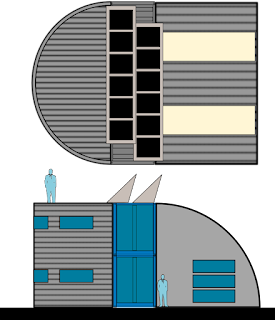
........the Techno HUT will touch down.
Life has tugged at him from all directions, he meets the call yet watches his back as he sorts through mis-information and mis-direction and the hidden agenda of others. They strive to keep him ignorant, not by keeping education from him but holding him off balance by uncertainty. A broad education is useless when specific skills are required and demanded (or is it?).
He battles the world out in the open, a hopeless war. He secludes himself and while resting commits to fixing the world with the info he is sure of. The world ridicules and mocks this kind of people. Nerds and geeks and such they call them. They are not outsiders like criminals, no, they are insiders. Too far inside. Too serious they say, lighten up, party, have fun! Under their breath, that nerd was Black, is there such a thing? How did that happen? They almost say out loud, "this one is an anomaly, but not important enough to be bothered with." I would have been happy if they just said it among themselves, but they said it to my folks, my neighbors, my teachers.
No one understands how or why I do what I do. I am compelled to do it. It's not a profession because that goes in a different direction, a different end. I must stay the course, despite my wobbly footing and the uncertainty that troubles me. And why can't I just accept what others have done with their reasoning and projected outcomes, I just don't know, but I see it differently. Few will listen, few invite my view. Are there others like me? In a world of communication we are kept apart by thought.
So he keeps to himself, buys a property and collects cast-off building materials. A silo because Africans have built graineries for centuries. A quonset hut because Blacks and quick shelter became indispensable in WW2. Cargo Shipping containers because today we import everything and Blacks were imported in the past. He fashions a dwelling by blending the forms together, calls it his HUT (Habitat for the Urban Terrain). He laughs because this Techno HUT is designed by a non-architect Black diaspora man at a spot where all his understanding converges.
It was a solitary pursuit in his mind, unbeknown to him these Techno HUTs began to appear globally in every place Black diaspora have been scattered.
I chose architecture because that is the info in me, what is in you? Perhaps you have passions and skills not required by your jobs and rather than let them languish and be forgotten, you covertly dabble and what if and say one day.............

........the Techno HUT will touch down.
Tuesday, March 09, 2010
video in the land of the watchers
Steampunk, the art of sliding forward and backward at the same time. No, not MJ's moonwalk, steampunk is realizing the future via the past. Like building a laptop PC into a typewriter. If you seen the movies Casper the Friendly Ghost, Jules Vern, The League of Extraordinary Men, or Sky Captain and the World of Tomorrow, you know what I am talking about. Sci-fi what-if art. Take an old oscilloscope cabinet and put a LCD screen in it's face and keep all the original details of the old cabinet.
Today I did something that had that steampunk feel to it. I watched The Day the Earth Stood Still on DVD. There were two in the box, the first was the original made in 1951. That was the year of my birth and I saw it in the theater probably about age 10 or so. Then I saw the other made in 2008 with Keanu Reeves and Jennifer Connelly. Technology changes rapidly, people change but it's like geological time. Both movies are very cool!! The comparing the nuances in acting and sensing the attitudes of the time they were made and what the technologies were and such, great fun.
My Ubuntu box has two video media players. The standard Gnome desktop player called Totem and VLC (VideoLan) an open source multi- platform media player. I always thought media players were a strange sort. While they can be used world wide there are different formats and codecs, some proprietary. This means some can't be included in the standard download for certain countries. Totem is just a movie player, VLC is a media player, does movies, audio playback, audio and video stream capture and receiving. VLC will run on Linux, Mac OS and Windows. With Linux in the distributions software repositories, the codecs are downloaded in sets, depending what the media player is based on. Totem uses Gstreamer codecs (good, bad and ugly). VLC has a more open plug-in architecture for third-partyware. It comes with most of the codecs, but I had to get the library to play commercial DVDs separately.
I like broadcast TV less and less as I get older. What was shameful when I was younger is now flaunted with disregard. This is why I like DVD's and think about having a PC plugged into my livingroom TV. Accepting bad stuff as good stuff is unacceptable and the slow slide to smut is not entertainment, but if you watch it all the time you'll never notice. I have wondered why folks wouldn't allow it to come through the front door, but through the TV is OK. Oh, it's virtual smut, it won't hurt you. Turn your head, I'll tell you when it's safe to look. I guess the best would be to have the ability to download the stuff you like in the background and view it when you have time.
There you have it, steampunk, movies, movie players in Linux and ethics in one blog. Man!
rno the artist unplugged
As an artist I find myself in continual development from many sources. This was not fully possible when I started on this trek. I used to go from library to library to find the book other libraries didn't have. I read magazine after magazine. And I did this because in college, the art history course I was in was stuck on the virtues of Roman and Greek art and architecture. I kept saying in my mind, this is not relevant. For perpetuating the flavor of those cultures in todays world maybe it was, but my heart kept saying "not relevant." Our present culture owes a lot to those early Euro civs, but after becoming aware of Africa, my origins, I could not have rest.
The media always has a shaded view of Africa. It is not that they are hiding stuff from us but more of a not mentioning because of no interest on their part. So when our national interest is disturbed, there is coverage. If the human atrocity meter rises too high, there is coverage. Any achievement or advancement or development on the African continent, it is not news. Over the years my view of Africa was uneducated, primitive natives. I had the same view of American Indians here, only they were uneducated savages. Tourist all want to go to Africa to see natives. It was the same for American Indians here.
I won't go deeper into the bias that has flavored life in the US since the get, we all know. And once this kind of flavor is institutionalized (it is deep in the dominate culture), it takes generations to ferret out and dilute.
The internet came to my rescue. The net allowed me to see history (art, social, national) from many different points of view. The most important questions for me was untwisting history. How stories, even histories, are told eventually becomes the guiding force for human worth, development and progress. If you are told your ancestors were slaves and you are the son of slaves and add to it a kind of loathing weightiness as if slavery was for lower lifeforms, guess what happens to the people who must receive this story, this history? I have lived with the weight of this, even though Civil rights events were going on during my youth.
Young kids should hear untarnished history. My realization is that history is unappreciated until you have lived some. Older folks all appreciate history. But kids should hear history because it is the shaping force. American history has a lot of lies, if we can expose them and fill in the blank spots, we will raise up an intelligent and thoughtful generation. It is our history "story" that has damaged America. We have a saying about history repeating itself. Actually we perpetuate the lies and tell kids it is their right of passage to repeat. I am so amused at how as adults we know the truth yet resist. We lie with boldness and tell the truth with uncertainty. We know what kind of kids the lie will produce, we are not sure what the truth will produce. Yet in our hearts we want kids to be more enlightened, not just smarter. And we also are afraid of that. I have heard parents say, "he didn't learn that from me!" I am talking about the good stuff.
But we are talking about art and design here. The internet has allowed me to see the art and design of other cultures, especially African. From the top to the bottom of Africa, with and without the Euro influence, African art is pretty impressive. And although I can not directly have a cultural tie (been in America too many generations), I can feel some empathy. Not because of the events of history but because there is a sensibility in the way I think about art that is akin to the ways of Africa. This is expressed in a simple statement I heard in an interview of an African craftsperson. He said, "I just want to make beautiful things." This artist was not in the Euro art tradition of schools and galleries and expositions and art as a part of human accomplishment or art for fame or art as an investment or art for historical reference and documentation. He just wanted to make beautiful things.
I myself do abstract, non-object art, decorative. Many black artist do faces, the human form, black faces, black persons in life. While I think drawing and painting black people is wonderful, I am not that kind of artist. Perhaps with abstracts, you can not tell what color the artist is, that is OK with me, why should you care? That's rhetorical! Many of the stories we tell as artist have nothing to do with color as a race marker and sometimes that kind of art perpetuates the lie. Even in my abstract, I should have references to my past, my origins, my struggle to overcome, or to protest, pay homage to or to praise, or to hope. Well, if those things happen in my art, I will not force them to exist, they will just be there. If you recognize them in my work, that is the message it speaks to you.
Abstract art is like jazz, many black abstract artist have said this. I first heard John Coltrane and the critics said he was angry, expressing anger, Archie Shepp and others. The times were angry with civil rights and such. They thought for sure these musicians were the voice of the times. No, the anthems for that time was "We shall overcome" and "Lift every voice and sing". Jazz was not angry voices, it was pent up creative energy being "freely" released. Motown on the other hand was about a finely cultivated art form moving toward wide acceptance. It was saying we ain't no gull dang minstrel show, we don't shuck and jive, we are respectable high quality entertainment. We raise the bar using our own faces (not in whiteface). Motown was my right of passage, jazz was my liberation. Jazz was about how we black folks do things, camaraderie and one-up-man-ship at the same time. Even today when I walk through a store, I nod in appreciation to every black face who acknowledges hello. It is within even if that other person has other thoughts, or a challenge or a delusion. That "jazz" is inside and I can see it. I only see that in a few Euro folks, here and there. I don't understand that and perhaps it's just my bias, yeah, I got some too.
Today jazz is so watered down in the media. Coltrane on the radio turned into nightclub jazz into smooth jazz into elevator music into popular vocal music. Now I hear jazz radio late at night and mostly it is mainstream, the heady avant-gard stuff is so rare it is practically gone. It is the same for abstract art. There is this dime a dozen attitude and a we can tell which Euro artist influenced you. So blacks drawing black faces is original and blacks drawing abstractly is copying white guys (who studied black guys).
Then you got to fit into some style, school of art, some movement or historical reference or.......... I'm telling you, if an artist is burdened with this kind of stuff on the front end, there is no art on the back end. I will reveal the art process one more time. There is this person who discovers by whatever means the ability to create and goes about doing that. He or she acquires skills and gathers whatever views that form their world view and reference information that flows through their senses. It all converges in the mind and flows out into what ever media is being used, wither a dream or paper or canvas or camera or computer, a building, clothes, etc, etc, etc. You see it, hear it, and go, "oh, wow, that's art." Simplistic.
Why I do art the way that I do? "I just want to make beautiful things."
Monday, March 08, 2010
get off it and get with it
There are plenty who describe Linux with all the techie flavor and the smell of singed circuit boards to boot (that's a pun, son). I, your Linuxville guide, am not here to give the you the technosis but the play by play. Living with Linux is possible. "Ah man, Linux ain't so great, they ain't got no good games." No, Linux has no Xbox, or PS2 or Wii or MS or Mac games, but does have lots of Linux games and how would I know, I don't play many games anyway. So, I don't say much about what I don't do much, OK?
I am more like a backyard mechanic only my passion is art and architecture. Hey, I said passion, not obsession! You try building what ever building pops into your head. Making paintings is cheap compared to buildings. The architectural idea is a way of visualizing building possibilities. If one gets the chance to build a dream house, then that is icing on the cake. My major problem is that I see so many possibilities and regard architecture as art. I usually do the reverse of good design practice by putting the form above the function. I like creating a space then defining what you can do in that space. I see no diff between a tent, cabin or warehouse loft. It is just a space to figure out how to live in it. The really only critical thing is utilities and services, the rest is open to your whims.
In my exploration of form I have fallen in love with several semi-prefab situations that have been used in my lifetime. Quonset huts, geodesic domes, grain silos (short ones) and now cargo containers (tall ones). If you use them by themselves you can only go so far, but if you can combine them, blend them, you begin to form many interesting possibilities. So I never say I am going to live in a quonset hut or any of the other forms alone. That to me would be boring and simplistic. Cargo containers are square no matter how you stack and wrap. To take the emphasis off the cube warms the form, humanizes the form so that it is more inviting.

I can see a roof garden, solar arrays, glass here and there. The form itself is a stack of cargo containers and a silo split in two and put on each end. Simple and exploitable form.
 In this idea the quonset houses the open half and the containers the more private spaces. But who is to say how you live in this kind of building.
Now over a couple of blogs I have given you some good ideas to use cargo containers with other semi-prefab building forms. The results are interesting spaces and lots of design possibilities. I don't care if you use them or not. The point is that you dream and design differently. The point is satisfying spaces and wonderful forms. The point is that architecture is not just for the rich and famous or for the corporate world. We don't have to equate domestic architecture with cereal boxes or force average people to live in surreal boxes. Using the forms we already have but neglect to use, we can give everybody an upgrade.
Hey Linux folks, you gonna let them get away wid that? I'm talking about the task bar. Yeah, I know, Mac has that animated icon bar and big icons that are actually running miniature apps and Mac OSX is the desktop to copy and emulate and borrow from. What about Vista/Win7? Oh, they only got Aero, no wait, ribbons (sic), they got ribbons. Look again, that ribbon on the desktop is a taskbar. It's a better, more useful taskbar than what's standard in Linux, the desktop pager. In fact the Linux pager has not been upgraded since the beginning. It still switches desktops and shows a teeny, tiny miniature of the windows on that desktop. If you got composting activated, you can alt-tab and get...........look, I can put a panel on all four sides of my screen and hide/expose them with a mouse move. We have used document thumbnails for centuries in our file browsers, why the heck can't we put them in our pager? Maybe because the MS ribbon taskbar is open window oriented and the Linux pager is desktop workspace oriented. You can have many windows open on each desktop workspace, where as in MS Win, it's about managing just open windows in one workspace. Which is better is a matter of how you work with it. The puzzle is when you multi-task, what is the fastest way to your data and if running apps in different windows and different workspaces are able to interact and look good too.
So, here is Linuxville the personal PC becomes the means for an active creative life. Sometimes it ain't pretty, sometimes pretty funny but mostly pretty interesting. If I have more time and inclination, I will progress to finess of presentation and maybe even 3D. I might even make a movie out of my avatar, "oh, someone did that already!"
I am more like a backyard mechanic only my passion is art and architecture. Hey, I said passion, not obsession! You try building what ever building pops into your head. Making paintings is cheap compared to buildings. The architectural idea is a way of visualizing building possibilities. If one gets the chance to build a dream house, then that is icing on the cake. My major problem is that I see so many possibilities and regard architecture as art. I usually do the reverse of good design practice by putting the form above the function. I like creating a space then defining what you can do in that space. I see no diff between a tent, cabin or warehouse loft. It is just a space to figure out how to live in it. The really only critical thing is utilities and services, the rest is open to your whims.
In my exploration of form I have fallen in love with several semi-prefab situations that have been used in my lifetime. Quonset huts, geodesic domes, grain silos (short ones) and now cargo containers (tall ones). If you use them by themselves you can only go so far, but if you can combine them, blend them, you begin to form many interesting possibilities. So I never say I am going to live in a quonset hut or any of the other forms alone. That to me would be boring and simplistic. Cargo containers are square no matter how you stack and wrap. To take the emphasis off the cube warms the form, humanizes the form so that it is more inviting.

I can see a roof garden, solar arrays, glass here and there. The form itself is a stack of cargo containers and a silo split in two and put on each end. Simple and exploitable form.

Now over a couple of blogs I have given you some good ideas to use cargo containers with other semi-prefab building forms. The results are interesting spaces and lots of design possibilities. I don't care if you use them or not. The point is that you dream and design differently. The point is satisfying spaces and wonderful forms. The point is that architecture is not just for the rich and famous or for the corporate world. We don't have to equate domestic architecture with cereal boxes or force average people to live in surreal boxes. Using the forms we already have but neglect to use, we can give everybody an upgrade.
--subject shift!!--
Hey Linux folks, you gonna let them get away wid that? I'm talking about the task bar. Yeah, I know, Mac has that animated icon bar and big icons that are actually running miniature apps and Mac OSX is the desktop to copy and emulate and borrow from. What about Vista/Win7? Oh, they only got Aero, no wait, ribbons (sic), they got ribbons. Look again, that ribbon on the desktop is a taskbar. It's a better, more useful taskbar than what's standard in Linux, the desktop pager. In fact the Linux pager has not been upgraded since the beginning. It still switches desktops and shows a teeny, tiny miniature of the windows on that desktop. If you got composting activated, you can alt-tab and get...........look, I can put a panel on all four sides of my screen and hide/expose them with a mouse move. We have used document thumbnails for centuries in our file browsers, why the heck can't we put them in our pager? Maybe because the MS ribbon taskbar is open window oriented and the Linux pager is desktop workspace oriented. You can have many windows open on each desktop workspace, where as in MS Win, it's about managing just open windows in one workspace. Which is better is a matter of how you work with it. The puzzle is when you multi-task, what is the fastest way to your data and if running apps in different windows and different workspaces are able to interact and look good too.
So, here is Linuxville the personal PC becomes the means for an active creative life. Sometimes it ain't pretty, sometimes pretty funny but mostly pretty interesting. If I have more time and inclination, I will progress to finess of presentation and maybe even 3D. I might even make a movie out of my avatar, "oh, someone did that already!"
Saturday, March 06, 2010
it started with a push of a button
I found a convergence in the force. Everybody's is getting metaclorian treatments, shots and patches. Metaclorians, the little cyber buggies that exist in technology users. Too few and you're a hunter-pecker, too many and you are a technophobe (geek, nerd, guru, wizard, hacker, cracker, iPodalist, iPhonamorph, Blackberry addict, Palmist and textologist.) You never know what you will become. It is getting so rampant folks with too many are given to hand gestures. They wave the hand and stuff happens, including getting a reactions from me.
An FDA (First Digital Accessory Inc. (what'd you think!)) clinical trial locked a man in a glass box with a solitary pushbutton until he feverishly pushed it in hope of accomplishment. The button does nothing. In the mind of the pusher, it was evoking powerful thoughts, the brain activity was off the chart. The scientist came in one night and found the box shattered by thought, so they thought. Surveillance video showed that the button got stuck and the pusher started pushing all the surfaces of the glass. He escaped, leaving a trail of finger indents down the hall. News reports flashed (no thanks to Adobe) stories of kids being pushed down and cats off the fences and cars down the street and shopping carts..... The public outcry was so dramatic, someone even wrote a song about it. "Gawl dang the pusher man."
People started imitating and mimicking, pushing each other in jest and with intent and saying when they agreed with another "I'm pushed" and when cornered "don't push me!" Pushing became a popular marketing tool and political tactic. Soon there was treatment centers for cronic-pushers, because scientist isolated the genome that started this whole thing, "Hey, haven't we seen this before, yeah dude, I'm pushed."
Meanwhile a "grassroots" movement started to resist being pushed. They offered an alternative lifestyle. These folks would force themselves beyond hunt and peck, even though they could touch type (one button only required one finger). Methodically and meticulously they limited hand gestures to fork holding and waving hello. It is rumored some uttered sound in a kind of speech, you see talking was lost with texting. Forget plastic surgery, the going thing now is vocal cord stimulation and atrophy repair and elocution classes.
The saving grace of the entire world came with the invention of the keyboard which have more than one key on it. Folks could now use more than one finger. Their lives became more fulfilling and fruitful because now they could use the whole hand instead of pointing the finger.
I think it is amazing with all the DNA science and such, the most damming evidence is still a fingerprint. Ever wonder why the single most popular laptop PC security device is the fingerprint reader?
What about that guy who escaped the FDA? His finger poking is so advanced and his mind so twisted, he went underground. Rumor has it he is the cause of water-line fractures across the US. Records show a family history starting with a man with his finger caught in a dike. I see kids all over with fingers up their noses (I never did that, got a Kleenex?). He is so legendary we gesture in his honor "flippin the bird" we call it. He is known as Big-Foot because Big-Finger is so distasteful. Industry, even NASA has celebrated his contribution, what machine doesn't have a big red one finger driven panic button?
Think I'm coo-coo!, what about that painting by Michaelangelo, you know the one where God is reaching down with one hand, finger extended to touch a human hand with finger extended. Michael, what did you see? Oh, you splashed paint in your eye, have to wipe. Yeah, I'm pushed!
come on, laugh, push the button and laugh!!
Linux is fine, the world is whacked
Linuxville is a virtual place where everybody is fine with Linux. It's the rest of the world that's nuts. Take hardware, my wonderful 15 inch HP LCD monitor just slowly croaked. The blue power button still lites but fade to black is not a desktop effect I wanted to see. Guess what I replaced it with, a big CRT!?! Now the hum of eddy currents and the cathode ray tube radiation penetrating my face is added to the hum of the PC box on the floor. A symphony of hums in a tone I can't harmonize with. The LCD was at least 5 years old, the CRT is 9 years old. There is no instant technology in there. It clanks and clicks at refresh and when I hit the degauss button the lint stands up and I can feel a wave of neutralizing energy as the screen jostles then settles down. Makes me feel like, "Hey iGor, hand me that beaker but don't push that but.....awk!!"
If my LCD was 5, so is my PC and even though it runs flawlessly well perhaps I should begin dreaming of new stuff. I want a laptop with some graphic power and a couple of LCD displays so I can recycle the CRTs. But they work so well. But they are energy pigs and space hogs.
For graphic folks the rule of the pinkey is to buy a game machine or similar. Games are mostly about graphics power but I think depending on the kind of graphics you do, the video card needs to be considered. CAD graphics is more about precision in virtual space and games is about speedily moving but mostly interaction while moving. There are cards for CAD and cards for games and cards that sort of, kind of, do both. Laptop users need an above average laptop for graphics work but not necessarily a gaming laptop. Video graphics folks should buy a game machine (perhaps like Alienware!).
I know if I buy a big screen, it better sit in the livingroom and get channel 5. So for my studio I want a digital video projector so that when I got the urge to blow it up I can. The other things for me is the Wacom Bamboo graphics tablet and a couple of bookshelf hard drives. Why? A friend just called me, an upgrade download just hosed his Vista laptop. I am telling you, the operating system should sit on the main drive by it self with the applications, you should keep a fresh install copy on a jump drive. Your precious data should be backed up on a portable drive. The operating system and personal data on the same drive is asking for trouble. Gee Arno, aren't you glad you use Linux!?, don't you wish everybody did? Yeah, but no! You do have a choice.
This is where I can boast the virtues of Linux. In my 10 years of adding security updates, Linux got hosed once or twice. With win95/98/98b/XP, several times with each version. Friends who have moved on to Vista are getting hit and there is more to come with win7. Why? because using Win OS changes the OS. The more you add applications and anti-virus and security tweaks and stuff, the more the registry changes. Updates from MS comes not anticipating the "amount of change" internally to "your system". If all the registry chickens don't line up the rooster doesn't crow (system fails to boot). It maybe one number off, how would you know? Ah yes, the BSD (blue screen of death).
Murder by asphyxiation of the digital cortex (cpu). Crime scene tape wrapped around the computer. "I tried everything to resuscitate it, even deep hard drive stimulation." "There was nothing you could do at this point Mr. Arno (should have taken preventive measures). Must have been an untreated infection or glitch. Was there any signs?" "Yes, but I thought is was a trimmer in the force, I mean power fluctuations." "We'll have to perform an autopsy."
"Mr. Arno, your system is whacked, we'll have to reformat your drive (erase your memoirs) and re-install Windows. That will be many dollars and 39 cents." I'm thinking, making a backup of the last working system install is too much trouble.... and/or setting that last working system breakpoint date is........ and coping my personal data and pictures to CD/jump drive/other hard drive is.........then all my tweaks and settings and....."Hey, why 39 cents???" "Tax, title, license, and learner's certificate, we'll train you to do......." "Man I've been at this for years, I don't need no class, no geek training." "It's geek habit user reprogramming Mr Arno. It's completely voluntary, an unfunded mandate for ID thief and personal loss prevention. It's this or neural implants via iPod web casts for 6 weeks!" "I ain't got time for this." "Yes, my young padawan learner, that is why you fail, there is no try, only do or not do and pay me." "Or pay me!" The call from the end of the counter (bluish guy, short, wings flapping like a humming bird). "What kind of PC, yeah, Nubian I think! We let the fate decide, I have a chance cube!" Man, a hack with one dice, the ways of the farce vs the ways of the force, I just want my PC fixed like it was, darn, I forgot the red shoes, can't go home. "Mr. Arno, take the blue pill (buy a new system) or the red pill (reformat and install), see how far this rabbit hole goes." Name is Arno not Neal." "Sorry, thought we were doing movies."
Subscribe to:
Posts (Atom)