Now that I stuck my nose in the flower and got stung, I have to explain it to everyone who ask the obvious. They always ask how but not why, except for smart-alicks. Don't use the medical jargan, say "man what a rush!"
You see the flower in this case is Blender 3D and the bee is its user interface. It is repeated that the Blender interface is difficult and hard and has a steep learning curb (a pain, it stings). But once you nose around you will get zapped, marked for life as it were, a Blenderhead.
To the casual observer the interface resembles a Borg spaceship, this is why the reports are out there. Don't stick your nose in there! Thankfully there are video tutorials that take the mystery out of Blender, oh! you will get stung! But if you don't get the basics down your nose will look like a red-skin potato. So my advice to would be Blenderheads, check out http://library.creativecow.net/ and click on the Blender 3D Survival Guide 1 thru 9. Paolo Cicone explains Blender via a simple animation project, you will get stung. But instead of a mass of scar tissue, you will have a red dot and that stupid smile of accomplishment.
Ok, the Batman movie where he had to climb the obscene terrain to get the blue flower, only to have it made into a disillusion powder. Or, the Snuggle bear, dancing through fields of fragrance. Believe it or not, you can do both in Blender, but you got to start somewhere.
Any good graphics application requires a right of passage, Blender is no different. You may be a hard edge know it all, able to learn it without any help. Why waste the time and energy figuring when that part has been pre-digested for you. Get the vids, learn the stuff, save your grunts for the really hard stuff, content.
Blender 3D comes in 4 flavors, Linux, Mac, BSD, and Microsoft, because it is Open Source. There is abundant documentations, tutorials, videos, artwork and finished products as in movie effects, cartoons and stills. You can make models, import models and...........
Also notice that on the Creative Cow site the other application vids that are there. But I advise Blend first unless you got stuck in those other fields.
So, this is the Linuxville guide dude, buzzing off to render in the splender of Blender. And don't forget to visit http://linuxgraphicsusers.com/forum/
for tips, help, chat, boasting and bragging and critique.
Friday, April 09, 2010


Wednesday, April 07, 2010
smelling the flowers risks a bee stung nose
I walk past them every day, the flowers.
every color calls to me, every form.
I take pictures and sketch them, I invent new ones,
the ideas come so fast and I can see them printed on everything.
Then I get mad, I can't do them justice, I can't capture what I see.
I don't really do flowers but in order to do them I must bend over and stick my nose into one flower.
It's my personal dilemma, having art in me but not spending the time on the means of expression. I have surveyed many art softwares and fumbled with my digital pen and pad. It is now time to commit to the art process.
You have to laugh, it is sort of like the movie Karate Kid, Mr. Miagi gets the kid to clean the house, the car and the the boy wants to kick butt. You have to train your body in a kind of language. You have to let the media train you before you can bend, stretch and alter the media. How the brush is loaded with paint, how it applied with your movements, how it feels and looks. It is the same with digital art. You learn the interface, the tools, the effects, all in an interactive "play".
The hardest thing for me is accepting that the process is slower than how I think. I just conceive the idea, record it in my sketchbook and I am done. I need to take the time to develop the idea via the process. You get a busy life, a sketchbook becomes a convenient way to keep the creative juices flowing between circumstances. It also become a pit. For an artist's main expression to be his sketchbook is not productive at all. It is not the number of ideas to fill up a sketchbook, but the completeness of each idea.
Like kids you gave birth to, now you got to raise them up. You get a great idea, you need to give it time to develop and mature with you.
To me I've always had the art viewers mind. There is a kind of excitement to roam a museum or gallery and oogle till my eyes are bloodshot. The actual work an artist does is really work the viewer doesn't appreciate. Time spent till the tools and techniques are transparent and fluid and the experimenting and risking and the great accidents and the flubs, these are mostly hidden. Well, what about performance art? Even there, a big part of the process you don't see is the prep. An artist does the process.
You got a big red nose because you stopped, bent over and stuck your nose in the flower and got stung. You smelled the aroma, got a little dust on your cheek. You looked the bee right in the eye as he buzzed madly, "don't poke your nose into my business!" You yell, then laugh, embarrassed but with a satisfying grin.The neighbors snicker, " that'll learn ya", I wouldn't have done that!", "serves ya right!".
To be an artist is to stop and actually smell the flowers everybody talks about. To be an artist is not without risk, so hold your big red nose in high esteem and open display.
every color calls to me, every form.
I take pictures and sketch them, I invent new ones,
the ideas come so fast and I can see them printed on everything.
Then I get mad, I can't do them justice, I can't capture what I see.
I don't really do flowers but in order to do them I must bend over and stick my nose into one flower.
It's my personal dilemma, having art in me but not spending the time on the means of expression. I have surveyed many art softwares and fumbled with my digital pen and pad. It is now time to commit to the art process.
You have to laugh, it is sort of like the movie Karate Kid, Mr. Miagi gets the kid to clean the house, the car and the the boy wants to kick butt. You have to train your body in a kind of language. You have to let the media train you before you can bend, stretch and alter the media. How the brush is loaded with paint, how it applied with your movements, how it feels and looks. It is the same with digital art. You learn the interface, the tools, the effects, all in an interactive "play".
The hardest thing for me is accepting that the process is slower than how I think. I just conceive the idea, record it in my sketchbook and I am done. I need to take the time to develop the idea via the process. You get a busy life, a sketchbook becomes a convenient way to keep the creative juices flowing between circumstances. It also become a pit. For an artist's main expression to be his sketchbook is not productive at all. It is not the number of ideas to fill up a sketchbook, but the completeness of each idea.
Like kids you gave birth to, now you got to raise them up. You get a great idea, you need to give it time to develop and mature with you.
To me I've always had the art viewers mind. There is a kind of excitement to roam a museum or gallery and oogle till my eyes are bloodshot. The actual work an artist does is really work the viewer doesn't appreciate. Time spent till the tools and techniques are transparent and fluid and the experimenting and risking and the great accidents and the flubs, these are mostly hidden. Well, what about performance art? Even there, a big part of the process you don't see is the prep. An artist does the process.
You got a big red nose because you stopped, bent over and stuck your nose in the flower and got stung. You smelled the aroma, got a little dust on your cheek. You looked the bee right in the eye as he buzzed madly, "don't poke your nose into my business!" You yell, then laugh, embarrassed but with a satisfying grin.The neighbors snicker, " that'll learn ya", I wouldn't have done that!", "serves ya right!".
To be an artist is to stop and actually smell the flowers everybody talks about. To be an artist is not without risk, so hold your big red nose in high esteem and open display.
Friday, April 02, 2010
making change @will
One of the things I appreciate about Linux and especially Ubuntu is the @will command. You won't find it on your keyboard, it is a mental thing. Because so many resources are either built-in or available online and or in the software repositories, you can try out stuff @will.
Let's say you want to use the terminal to start applications because you are a dyed in the wool keyboard jockey. You could pop an icon with a mouse click, search and deploy through the main menu or install "Guake Terminal". What the heck is Guake Terminal?? World of wonders man, where have you been? No, I just discovered it myself. This Guake Terminal sits invisible in the background and comes forward with one keystroke (F12). No touchy the mouse for this! Type your command, fire away and hit F12 again to send it back into it's invisibility cloak. An icon appears in the panel to let you know it's there waiting and there are tweak preferences, if you must.
Like I said the @will thing is cool. When I use Synaptic to install stuff and if not satisfied, I can gently removed them leaving behind config file residue or remove all traces. I have scrunched my changing down to here and there. A change of scenery is fine tuned with the help of Desktop Drapes. This app lets you change wallpaper from a directory by clicking on the tray icon or at a timed interval. Change is good, but not too much change. You can over do desktop dynamics to where your senses are overloaded. Excitement and adventure, a Jedi does not seek! Just think if Skywalker were sliding down the chute at Bespin and said "man I got ta do that again!"
Heads up display, I want a heads up display!! If you ever messed with Conky, you'd want one too. In the Crunchbang Linux distro, Conky is standard. Conky is a system monitor with the ability to list a text file and other stuff. In Crunchbang it had the system info on top and on the bottom a list of keyboard shortcuts. If you have a short memory like me you'd see how wonderful this is not to have a sheet of paper. It is on the screen as I train myself. And like all heads up display you can make the background transparent so as not to obscure the desktop. I am wanting two things. To be able to put Conky on a side panel that auto hides or disappears with a key stroke like Guake does. Then a resource file display thing so that when I am using Blender I get the Blender shortcut list and when in Gimp, I get the Gimp shortcut list. Of course if the Gnome panel could display a text file then Conky would be an optional thing.
Let's say you want to use the terminal to start applications because you are a dyed in the wool keyboard jockey. You could pop an icon with a mouse click, search and deploy through the main menu or install "Guake Terminal". What the heck is Guake Terminal?? World of wonders man, where have you been? No, I just discovered it myself. This Guake Terminal sits invisible in the background and comes forward with one keystroke (F12). No touchy the mouse for this! Type your command, fire away and hit F12 again to send it back into it's invisibility cloak. An icon appears in the panel to let you know it's there waiting and there are tweak preferences, if you must.
Like I said the @will thing is cool. When I use Synaptic to install stuff and if not satisfied, I can gently removed them leaving behind config file residue or remove all traces. I have scrunched my changing down to here and there. A change of scenery is fine tuned with the help of Desktop Drapes. This app lets you change wallpaper from a directory by clicking on the tray icon or at a timed interval. Change is good, but not too much change. You can over do desktop dynamics to where your senses are overloaded. Excitement and adventure, a Jedi does not seek! Just think if Skywalker were sliding down the chute at Bespin and said "man I got ta do that again!"
Heads up display, I want a heads up display!! If you ever messed with Conky, you'd want one too. In the Crunchbang Linux distro, Conky is standard. Conky is a system monitor with the ability to list a text file and other stuff. In Crunchbang it had the system info on top and on the bottom a list of keyboard shortcuts. If you have a short memory like me you'd see how wonderful this is not to have a sheet of paper. It is on the screen as I train myself. And like all heads up display you can make the background transparent so as not to obscure the desktop. I am wanting two things. To be able to put Conky on a side panel that auto hides or disappears with a key stroke like Guake does. Then a resource file display thing so that when I am using Blender I get the Blender shortcut list and when in Gimp, I get the Gimp shortcut list. Of course if the Gnome panel could display a text file then Conky would be an optional thing.
Monday, March 29, 2010
Blender is not that hard, K3D is coming along.
Gentleman, choose your weapons. It's a level playing field today, the sun is high and the media blimp is up there also proving once again that elephants do fly.
Among all the 3d graphics applications there is no best best ones. You can see this better on the Linux platform where folks are articulate and picky. The underlaying math either does it or doesn't and that is veiled by a thin GUI layer. Without a doubt the so-called best is thought of as the one where you can tweak everything but the name. But wait, there is another, so suave and sophisticated, you only have to gesture and it's done. Who shall hold the title as the best all around 3D graphics application is anybody's guess. OK anybody, it's your guess, you've got 30 seconds and the clock is ticking. tick, tick, tick...........wait he's going back to get his pencil. He's writing something, holding up a sign. "NOT ENOUGH TIME!
I know that. Here in the Linuxville guide château where the idea has been to survey, see what's out there, has come to realize the GUI is the "interface" or the "in your face", it's what's behind it that matters, mostly. Maybe the GUI is a little shack sitting on an immense catacomb of capability. Maybe the GUI is a 27 bedroom mansion with a matching basement. If you want 2D graphics, you can hit-n-run with a paint program, or get serious with a photo editor. 3D gives you no option, you must move in, stay there for a while and learn the secrets.
Hey, Mr.rno, you been messin wid K3D, how's it going? Well there's some work slowdowns, because the documentation to go further is not user friendly enough. There is too much I have to figure out to really do something. Even if I spent the time some things are awkward for a noobie-won. K3D is not bad for making model geometry, but gets laborious beyond that. I will keep poking at it to see if what's there will suffice.
I also am poking around Blender 3D. Folks need to stop saying the Blender interface is difficult to learn. True there is a lot of interface, but you don't use it all at once. The big thing with Blender is that there are video tutorials that show and tell, making a text and picture tutorial a pain in the eye socket. I have viewed several beginner tutorials and I feel pretty good about learning Blender.
So if you are wanting to model in Blender, you shouldn't be bothered by all the stuff for animation, unless you are doing animation. The secret of using Blender 3D is using it. The videos let you hear the interface explained, seeing it in action takes away the complexity. All those experienced Blender users are making forums buzz and video tutorials and models and games from the community make Blender a force to be reckoned with.
What would help Blender is not the shortcut keys on each command button, but using something like Conky. I encountered Conky in #!Crunchbang Linux. Conky is a heads-up on screen display that shows CPU temps, speed, etc and a text field which can list keyboard shortcuts. This is so cool and handy.
Among all the 3d graphics applications there is no best best ones. You can see this better on the Linux platform where folks are articulate and picky. The underlaying math either does it or doesn't and that is veiled by a thin GUI layer. Without a doubt the so-called best is thought of as the one where you can tweak everything but the name. But wait, there is another, so suave and sophisticated, you only have to gesture and it's done. Who shall hold the title as the best all around 3D graphics application is anybody's guess. OK anybody, it's your guess, you've got 30 seconds and the clock is ticking. tick, tick, tick...........wait he's going back to get his pencil. He's writing something, holding up a sign. "NOT ENOUGH TIME!
I know that. Here in the Linuxville guide château where the idea has been to survey, see what's out there, has come to realize the GUI is the "interface" or the "in your face", it's what's behind it that matters, mostly. Maybe the GUI is a little shack sitting on an immense catacomb of capability. Maybe the GUI is a 27 bedroom mansion with a matching basement. If you want 2D graphics, you can hit-n-run with a paint program, or get serious with a photo editor. 3D gives you no option, you must move in, stay there for a while and learn the secrets.
Hey, Mr.rno, you been messin wid K3D, how's it going? Well there's some work slowdowns, because the documentation to go further is not user friendly enough. There is too much I have to figure out to really do something. Even if I spent the time some things are awkward for a noobie-won. K3D is not bad for making model geometry, but gets laborious beyond that. I will keep poking at it to see if what's there will suffice.
I also am poking around Blender 3D. Folks need to stop saying the Blender interface is difficult to learn. True there is a lot of interface, but you don't use it all at once. The big thing with Blender is that there are video tutorials that show and tell, making a text and picture tutorial a pain in the eye socket. I have viewed several beginner tutorials and I feel pretty good about learning Blender.
So if you are wanting to model in Blender, you shouldn't be bothered by all the stuff for animation, unless you are doing animation. The secret of using Blender 3D is using it. The videos let you hear the interface explained, seeing it in action takes away the complexity. All those experienced Blender users are making forums buzz and video tutorials and models and games from the community make Blender a force to be reckoned with.
What would help Blender is not the shortcut keys on each command button, but using something like Conky. I encountered Conky in #!Crunchbang Linux. Conky is a heads-up on screen display that shows CPU temps, speed, etc and a text field which can list keyboard shortcuts. This is so cool and handy.
Saturday, March 27, 2010
Hey, give me a break, I'm working on it!
You want to venture into the graphics world and being a free radical, you choose Linux as your platform of choice. Despite all the clamor and acclaim Macs and MS have in graphics you proceed down the proverbial "road less traveled."
Being a graphics person requires a basic understanding of art in general. A good sense of composition, color and some drawing skills, puts you in the park. It requires impressionable visionary skills but not to the extent of a photographic memory. For now a good enough mind set is OK, you can obsess and be a perfectionist later. Now if you are wanting to be a digital graphics person add to this the patience to follow through procedures.
We'll use the Jedi metaphor to illustrate. Once you get the hardware (light saber, digital pen or mouse) and the wardrobe (full length hoodie bathrobe), you must learn to use the force. While learning the force, you get the moves, think like a Jedi thinks. Once you know, you know, it all becomes intuitive. Then you don't think, just do or not do, there is no try (don't look at me, I also am a noobie-won learner).
It is like this for everyone. Pick up a pencil and draw, that is one thing, drawing well is another. Now add color, light and shade, considering foreground and background. Even using traditional media requires procedures, with computers it is more so. Computers do not automatically draw what you want. They process instructions that an artist/programmer puts in. You may push the draw circle button, know that the draw circle program activated by you, is a program. All digital art software is a collection of programs that sit under the means of your control, a GUI or graphical user interface or typed in instructions. The GUI makes drawing easier but also awkward because you must understand what it does, how it works and go on from there. This is where the term CAD (computer aided design) comes from. The force may be strong in you but the hardware and software must also be your allies.
The popular Mac and MS PC platforms have lots of graphics applications with a long train of experienced users. If you go that way, you could go far. I recommend not being so platform dedicated, be open to what you have access to, as skills are transferable. I also keep close tabs on graphics applications that are able to run on multiple platforms (Open Source), they insure a level of freedom of movement that is well appreciated. Also note that Open Source programs are not commercial so they are not advertised or marketed by a for profit company and most likely are free. You may not be aware of them or realize that the quality and usefulness of Open Source Software is quite high.
One problem with Linux graphics is always in the number of experienced users. For instance while Blender 3D has a huge following, other very useful graphics apps have smaller communities. This results in less documentation, less tutorials, less examples and less chance to be applied in a professional capacity. It could be a great program but the developer is too deep in his work, too far down the road and/or too busy to help a noobie-won. A community of users thus has users at various stages able to both asks questions and supply answers. The community in Linux is vital to learning anything.
So here's the thing. With computers, the promise is repeatable results and tweakable input so that different results is possible. The caveat, once you learn the GUI (graphical user interface), you might be stuck in that program (Blender folks know this, so do Photoshop folks). This is OK, if this program is your tool of choice. Just don't let familiarity mess you up, there could be better stuff waiting in the wings, but under exposed, getting bad press (from you) and just starting to have a viable and flourishing user community.
OK, lets get practical. I am looking at K3D a Linux graphics application. It is in active development and is starting to have a user community. Right now there are not that many tutorials, especially video tutorials. This is further frustrated by the many cut-n-paste internet K3D name drops by folks who are not actual users themselves. They always mention the name but repeat descriptions they found on the developer's site. Actual users promote good software to other users. Their enthusiasm and curoisity and creativity causes the same to rise up in many want-to-bi-wons. They become noobie-wons and the process goes on when they show what they can do with tutorials, finished work and bug fix suggestions, etc.
I usually read and view all the pictures first and look for tutorials that explain the interface and tools and then how to do something to start me drooling. Accomplishing something is how it's done. If you have used other graphics apps you have a leg up. I have but mostly 2D, so 3D is an eye opening experience and requires a little more umph!
Here's my screenshot to prove I have started.

The window in the middle is a preview rendering with no settings yet. In the online docs is a file called Simple Work Flow Example. It explains how to do what I have done above only using a cylinder and tapering the top. By doing this a few times and reading the text over and noting the changes in the parameter sidebar, you get the gist of what's going on. Forget technical perfection and accuracy at first, play. Play, never lose the ability to play. Play progress and play some more. When you ask why, you are ready to learn and advance. Then comes what if, now you are starting to use the force.
OK, get K3D and play, I don't want to sense any disturbances in the force.
Being a graphics person requires a basic understanding of art in general. A good sense of composition, color and some drawing skills, puts you in the park. It requires impressionable visionary skills but not to the extent of a photographic memory. For now a good enough mind set is OK, you can obsess and be a perfectionist later. Now if you are wanting to be a digital graphics person add to this the patience to follow through procedures.
We'll use the Jedi metaphor to illustrate. Once you get the hardware (light saber, digital pen or mouse) and the wardrobe (full length hoodie bathrobe), you must learn to use the force. While learning the force, you get the moves, think like a Jedi thinks. Once you know, you know, it all becomes intuitive. Then you don't think, just do or not do, there is no try (don't look at me, I also am a noobie-won learner).
It is like this for everyone. Pick up a pencil and draw, that is one thing, drawing well is another. Now add color, light and shade, considering foreground and background. Even using traditional media requires procedures, with computers it is more so. Computers do not automatically draw what you want. They process instructions that an artist/programmer puts in. You may push the draw circle button, know that the draw circle program activated by you, is a program. All digital art software is a collection of programs that sit under the means of your control, a GUI or graphical user interface or typed in instructions. The GUI makes drawing easier but also awkward because you must understand what it does, how it works and go on from there. This is where the term CAD (computer aided design) comes from. The force may be strong in you but the hardware and software must also be your allies.
The popular Mac and MS PC platforms have lots of graphics applications with a long train of experienced users. If you go that way, you could go far. I recommend not being so platform dedicated, be open to what you have access to, as skills are transferable. I also keep close tabs on graphics applications that are able to run on multiple platforms (Open Source), they insure a level of freedom of movement that is well appreciated. Also note that Open Source programs are not commercial so they are not advertised or marketed by a for profit company and most likely are free. You may not be aware of them or realize that the quality and usefulness of Open Source Software is quite high.
One problem with Linux graphics is always in the number of experienced users. For instance while Blender 3D has a huge following, other very useful graphics apps have smaller communities. This results in less documentation, less tutorials, less examples and less chance to be applied in a professional capacity. It could be a great program but the developer is too deep in his work, too far down the road and/or too busy to help a noobie-won. A community of users thus has users at various stages able to both asks questions and supply answers. The community in Linux is vital to learning anything.
So here's the thing. With computers, the promise is repeatable results and tweakable input so that different results is possible. The caveat, once you learn the GUI (graphical user interface), you might be stuck in that program (Blender folks know this, so do Photoshop folks). This is OK, if this program is your tool of choice. Just don't let familiarity mess you up, there could be better stuff waiting in the wings, but under exposed, getting bad press (from you) and just starting to have a viable and flourishing user community.
OK, lets get practical. I am looking at K3D a Linux graphics application. It is in active development and is starting to have a user community. Right now there are not that many tutorials, especially video tutorials. This is further frustrated by the many cut-n-paste internet K3D name drops by folks who are not actual users themselves. They always mention the name but repeat descriptions they found on the developer's site. Actual users promote good software to other users. Their enthusiasm and curoisity and creativity causes the same to rise up in many want-to-bi-wons. They become noobie-wons and the process goes on when they show what they can do with tutorials, finished work and bug fix suggestions, etc.
I usually read and view all the pictures first and look for tutorials that explain the interface and tools and then how to do something to start me drooling. Accomplishing something is how it's done. If you have used other graphics apps you have a leg up. I have but mostly 2D, so 3D is an eye opening experience and requires a little more umph!
Here's my screenshot to prove I have started.

The window in the middle is a preview rendering with no settings yet. In the online docs is a file called Simple Work Flow Example. It explains how to do what I have done above only using a cylinder and tapering the top. By doing this a few times and reading the text over and noting the changes in the parameter sidebar, you get the gist of what's going on. Forget technical perfection and accuracy at first, play. Play, never lose the ability to play. Play progress and play some more. When you ask why, you are ready to learn and advance. Then comes what if, now you are starting to use the force.
OK, get K3D and play, I don't want to sense any disturbances in the force.
Wednesday, March 24, 2010
when tech looses its luster
Boring! I've heard both kids and adults cry out. Adrenalin and thrill seekers want more, anything less is boring! Video media is the rage, especially immersive 3d. You can feel like your are there, that is, all your senses say you are there. But today we have a poor man's version of a holodeck. You put on the glasses, stare intently and hear from every corner of the room. In your high priced home theater you can buy chairs with servo lifts that pitch and tilt and sub-woofers that hum, rattle and growl sending the immersion experience to the brink of real. The Omni-max thing with surround video and sound. There you are standing on a mountain peak, the snow is blinding, the wind howling, only the air smells like popcorn and it's way too warm in the room.
Lets change the scene from a home theater setup to something more refined. You have a large dining room. Put up rear projection screens on four sides, minus the entrance. The projectors are short throw to save space. A small round 4 seat table or a square of Astro-turf and the picnic spread is all you need. Oh yes, a computer capable of coordinating 4 video feeds. Your schedule is busy, you get home late, the sun has already set. You walk in the room, recline, sip a drink, some finger food. Your eyes open and see trees and a lake and you hear birds. The air is scented with greenery and its cool breeze is whispering or your favorite piece of jazz playing in the background.
My fantasy? The room is quite, a lit tilt disc controller in the middle where I stand. I put on cyber gloves and shoes (Wii eat your heart out!), hit the cuff button to start the sequence. The music plays, the images tear across the screens as if flying, down river, through the Grand Canyon and across the galaxy. The music or the sound dips and soars with my movements. I can even paint on my screens precisely drawing or splattering arrays of color and I can have it in the foreground or the background with other video layers in front of it. I can record it all.
Now that I did all this virtual stuff, I got to go out and get bored with the real thing. It's not so bad, a tad bit unpredictable, I might get to like it. It's therapy for my media addiction called MISO or Media Induced Sensory Overload. Treatment includes living with all media shut off for long periods and talking with real people. Whole families are often effected thus family outings are key.
Believe me, you don't want the gov to step in, I saw a home red tagged and locked. The family was taken to a shelter with lower technology till media immersion timers were installed in the home. It was bad, a mud slinger unit was found as they were sports fanatics. They watched football, car races, soccer, off-road biking and ATV racing, etc. The kids came to school looking like Charlie Brown's Pig Pen and the dad a corporate exec, always looked like Indiana Jones. The glazed eyes only blinked when a dirty, blood stained hand was waved.
There is a new book out to retrain mothers to let their kids play without helmets and kneepads. The sandbox replaced with a mud box and satin green lawns replaced with sticks and stones. One frantic mom was arrested, she had a arsenal of kid protection devices. A rack of fire distinguisher sized sprays for disinfect, bug bites and sun screen. She got caught when she brandished a band-aid gun. It sprayed disinfect, pain suppressant and dispensed a wound dressing so fast, the kid had to recant his ouch statement, midstream. Coaches complained everywhere, "insubordinate kids" they said, "we say feel the burn and they say "why!" What ever happen to "shake it off, work through the pain?"
What is next? Sweat suits with built-in air bags for contact sports, bikes with welded on training wheels or gyro stabilizers, 911 becomes iOn-Star? Play by play medical monitoring where they don't have to ask you what your medical emergency is, they know before you do. "Mr. rno your heart rate is elevated, are you....... or are you blogging?" No, no, I'm Jediatric and my metaclorian count is too high!
Lets change the scene from a home theater setup to something more refined. You have a large dining room. Put up rear projection screens on four sides, minus the entrance. The projectors are short throw to save space. A small round 4 seat table or a square of Astro-turf and the picnic spread is all you need. Oh yes, a computer capable of coordinating 4 video feeds. Your schedule is busy, you get home late, the sun has already set. You walk in the room, recline, sip a drink, some finger food. Your eyes open and see trees and a lake and you hear birds. The air is scented with greenery and its cool breeze is whispering or your favorite piece of jazz playing in the background.
My fantasy? The room is quite, a lit tilt disc controller in the middle where I stand. I put on cyber gloves and shoes (Wii eat your heart out!), hit the cuff button to start the sequence. The music plays, the images tear across the screens as if flying, down river, through the Grand Canyon and across the galaxy. The music or the sound dips and soars with my movements. I can even paint on my screens precisely drawing or splattering arrays of color and I can have it in the foreground or the background with other video layers in front of it. I can record it all.
Now that I did all this virtual stuff, I got to go out and get bored with the real thing. It's not so bad, a tad bit unpredictable, I might get to like it. It's therapy for my media addiction called MISO or Media Induced Sensory Overload. Treatment includes living with all media shut off for long periods and talking with real people. Whole families are often effected thus family outings are key.
Believe me, you don't want the gov to step in, I saw a home red tagged and locked. The family was taken to a shelter with lower technology till media immersion timers were installed in the home. It was bad, a mud slinger unit was found as they were sports fanatics. They watched football, car races, soccer, off-road biking and ATV racing, etc. The kids came to school looking like Charlie Brown's Pig Pen and the dad a corporate exec, always looked like Indiana Jones. The glazed eyes only blinked when a dirty, blood stained hand was waved.
There is a new book out to retrain mothers to let their kids play without helmets and kneepads. The sandbox replaced with a mud box and satin green lawns replaced with sticks and stones. One frantic mom was arrested, she had a arsenal of kid protection devices. A rack of fire distinguisher sized sprays for disinfect, bug bites and sun screen. She got caught when she brandished a band-aid gun. It sprayed disinfect, pain suppressant and dispensed a wound dressing so fast, the kid had to recant his ouch statement, midstream. Coaches complained everywhere, "insubordinate kids" they said, "we say feel the burn and they say "why!" What ever happen to "shake it off, work through the pain?"
What is next? Sweat suits with built-in air bags for contact sports, bikes with welded on training wheels or gyro stabilizers, 911 becomes iOn-Star? Play by play medical monitoring where they don't have to ask you what your medical emergency is, they know before you do. "Mr. rno your heart rate is elevated, are you....... or are you blogging?" No, no, I'm Jediatric and my metaclorian count is too high!
Friday, March 12, 2010
Electric African and the Techno HUT
I have an on going story developing in my head. If you are a Black person with art and technology in your DNA, it is probably in your head also. I call it the "Electric African". He is a diaspora person, can't tell his exact origins besides the obvious. His history and his genetic path is twisted and convoluted, but in any case, he is the sum total, here in the present. His education is varied, with holes and gaps. Lucky are ones like him who master a narrow track in the schools of credentials. The broad education is promoted but not honored here.
Life has tugged at him from all directions, he meets the call yet watches his back as he sorts through mis-information and mis-direction and the hidden agenda of others. They strive to keep him ignorant, not by keeping education from him but holding him off balance by uncertainty. A broad education is useless when specific skills are required and demanded (or is it?).
He battles the world out in the open, a hopeless war. He secludes himself and while resting commits to fixing the world with the info he is sure of. The world ridicules and mocks this kind of people. Nerds and geeks and such they call them. They are not outsiders like criminals, no, they are insiders. Too far inside. Too serious they say, lighten up, party, have fun! Under their breath, that nerd was Black, is there such a thing? How did that happen? They almost say out loud, "this one is an anomaly, but not important enough to be bothered with." I would have been happy if they just said it among themselves, but they said it to my folks, my neighbors, my teachers.
No one understands how or why I do what I do. I am compelled to do it. It's not a profession because that goes in a different direction, a different end. I must stay the course, despite my wobbly footing and the uncertainty that troubles me. And why can't I just accept what others have done with their reasoning and projected outcomes, I just don't know, but I see it differently. Few will listen, few invite my view. Are there others like me? In a world of communication we are kept apart by thought.
So he keeps to himself, buys a property and collects cast-off building materials. A silo because Africans have built graineries for centuries. A quonset hut because Blacks and quick shelter became indispensable in WW2. Cargo Shipping containers because today we import everything and Blacks were imported in the past. He fashions a dwelling by blending the forms together, calls it his HUT (Habitat for the Urban Terrain). He laughs because this Techno HUT is designed by a non-architect Black diaspora man at a spot where all his understanding converges.
It was a solitary pursuit in his mind, unbeknown to him these Techno HUTs began to appear globally in every place Black diaspora have been scattered.
I chose architecture because that is the info in me, what is in you? Perhaps you have passions and skills not required by your jobs and rather than let them languish and be forgotten, you covertly dabble and what if and say one day.............
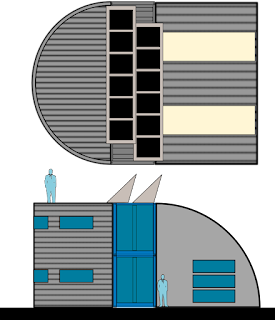
........the Techno HUT will touch down.
Life has tugged at him from all directions, he meets the call yet watches his back as he sorts through mis-information and mis-direction and the hidden agenda of others. They strive to keep him ignorant, not by keeping education from him but holding him off balance by uncertainty. A broad education is useless when specific skills are required and demanded (or is it?).
He battles the world out in the open, a hopeless war. He secludes himself and while resting commits to fixing the world with the info he is sure of. The world ridicules and mocks this kind of people. Nerds and geeks and such they call them. They are not outsiders like criminals, no, they are insiders. Too far inside. Too serious they say, lighten up, party, have fun! Under their breath, that nerd was Black, is there such a thing? How did that happen? They almost say out loud, "this one is an anomaly, but not important enough to be bothered with." I would have been happy if they just said it among themselves, but they said it to my folks, my neighbors, my teachers.
No one understands how or why I do what I do. I am compelled to do it. It's not a profession because that goes in a different direction, a different end. I must stay the course, despite my wobbly footing and the uncertainty that troubles me. And why can't I just accept what others have done with their reasoning and projected outcomes, I just don't know, but I see it differently. Few will listen, few invite my view. Are there others like me? In a world of communication we are kept apart by thought.
So he keeps to himself, buys a property and collects cast-off building materials. A silo because Africans have built graineries for centuries. A quonset hut because Blacks and quick shelter became indispensable in WW2. Cargo Shipping containers because today we import everything and Blacks were imported in the past. He fashions a dwelling by blending the forms together, calls it his HUT (Habitat for the Urban Terrain). He laughs because this Techno HUT is designed by a non-architect Black diaspora man at a spot where all his understanding converges.
It was a solitary pursuit in his mind, unbeknown to him these Techno HUTs began to appear globally in every place Black diaspora have been scattered.
I chose architecture because that is the info in me, what is in you? Perhaps you have passions and skills not required by your jobs and rather than let them languish and be forgotten, you covertly dabble and what if and say one day.............

........the Techno HUT will touch down.
Tuesday, March 09, 2010
video in the land of the watchers
Steampunk, the art of sliding forward and backward at the same time. No, not MJ's moonwalk, steampunk is realizing the future via the past. Like building a laptop PC into a typewriter. If you seen the movies Casper the Friendly Ghost, Jules Vern, The League of Extraordinary Men, or Sky Captain and the World of Tomorrow, you know what I am talking about. Sci-fi what-if art. Take an old oscilloscope cabinet and put a LCD screen in it's face and keep all the original details of the old cabinet.
Today I did something that had that steampunk feel to it. I watched The Day the Earth Stood Still on DVD. There were two in the box, the first was the original made in 1951. That was the year of my birth and I saw it in the theater probably about age 10 or so. Then I saw the other made in 2008 with Keanu Reeves and Jennifer Connelly. Technology changes rapidly, people change but it's like geological time. Both movies are very cool!! The comparing the nuances in acting and sensing the attitudes of the time they were made and what the technologies were and such, great fun.
My Ubuntu box has two video media players. The standard Gnome desktop player called Totem and VLC (VideoLan) an open source multi- platform media player. I always thought media players were a strange sort. While they can be used world wide there are different formats and codecs, some proprietary. This means some can't be included in the standard download for certain countries. Totem is just a movie player, VLC is a media player, does movies, audio playback, audio and video stream capture and receiving. VLC will run on Linux, Mac OS and Windows. With Linux in the distributions software repositories, the codecs are downloaded in sets, depending what the media player is based on. Totem uses Gstreamer codecs (good, bad and ugly). VLC has a more open plug-in architecture for third-partyware. It comes with most of the codecs, but I had to get the library to play commercial DVDs separately.
I like broadcast TV less and less as I get older. What was shameful when I was younger is now flaunted with disregard. This is why I like DVD's and think about having a PC plugged into my livingroom TV. Accepting bad stuff as good stuff is unacceptable and the slow slide to smut is not entertainment, but if you watch it all the time you'll never notice. I have wondered why folks wouldn't allow it to come through the front door, but through the TV is OK. Oh, it's virtual smut, it won't hurt you. Turn your head, I'll tell you when it's safe to look. I guess the best would be to have the ability to download the stuff you like in the background and view it when you have time.
There you have it, steampunk, movies, movie players in Linux and ethics in one blog. Man!
Today I did something that had that steampunk feel to it. I watched The Day the Earth Stood Still on DVD. There were two in the box, the first was the original made in 1951. That was the year of my birth and I saw it in the theater probably about age 10 or so. Then I saw the other made in 2008 with Keanu Reeves and Jennifer Connelly. Technology changes rapidly, people change but it's like geological time. Both movies are very cool!! The comparing the nuances in acting and sensing the attitudes of the time they were made and what the technologies were and such, great fun.
My Ubuntu box has two video media players. The standard Gnome desktop player called Totem and VLC (VideoLan) an open source multi- platform media player. I always thought media players were a strange sort. While they can be used world wide there are different formats and codecs, some proprietary. This means some can't be included in the standard download for certain countries. Totem is just a movie player, VLC is a media player, does movies, audio playback, audio and video stream capture and receiving. VLC will run on Linux, Mac OS and Windows. With Linux in the distributions software repositories, the codecs are downloaded in sets, depending what the media player is based on. Totem uses Gstreamer codecs (good, bad and ugly). VLC has a more open plug-in architecture for third-partyware. It comes with most of the codecs, but I had to get the library to play commercial DVDs separately.
I like broadcast TV less and less as I get older. What was shameful when I was younger is now flaunted with disregard. This is why I like DVD's and think about having a PC plugged into my livingroom TV. Accepting bad stuff as good stuff is unacceptable and the slow slide to smut is not entertainment, but if you watch it all the time you'll never notice. I have wondered why folks wouldn't allow it to come through the front door, but through the TV is OK. Oh, it's virtual smut, it won't hurt you. Turn your head, I'll tell you when it's safe to look. I guess the best would be to have the ability to download the stuff you like in the background and view it when you have time.
There you have it, steampunk, movies, movie players in Linux and ethics in one blog. Man!
rno the artist unplugged
As an artist I find myself in continual development from many sources. This was not fully possible when I started on this trek. I used to go from library to library to find the book other libraries didn't have. I read magazine after magazine. And I did this because in college, the art history course I was in was stuck on the virtues of Roman and Greek art and architecture. I kept saying in my mind, this is not relevant. For perpetuating the flavor of those cultures in todays world maybe it was, but my heart kept saying "not relevant." Our present culture owes a lot to those early Euro civs, but after becoming aware of Africa, my origins, I could not have rest.
The media always has a shaded view of Africa. It is not that they are hiding stuff from us but more of a not mentioning because of no interest on their part. So when our national interest is disturbed, there is coverage. If the human atrocity meter rises too high, there is coverage. Any achievement or advancement or development on the African continent, it is not news. Over the years my view of Africa was uneducated, primitive natives. I had the same view of American Indians here, only they were uneducated savages. Tourist all want to go to Africa to see natives. It was the same for American Indians here.
I won't go deeper into the bias that has flavored life in the US since the get, we all know. And once this kind of flavor is institutionalized (it is deep in the dominate culture), it takes generations to ferret out and dilute.
The internet came to my rescue. The net allowed me to see history (art, social, national) from many different points of view. The most important questions for me was untwisting history. How stories, even histories, are told eventually becomes the guiding force for human worth, development and progress. If you are told your ancestors were slaves and you are the son of slaves and add to it a kind of loathing weightiness as if slavery was for lower lifeforms, guess what happens to the people who must receive this story, this history? I have lived with the weight of this, even though Civil rights events were going on during my youth.
Young kids should hear untarnished history. My realization is that history is unappreciated until you have lived some. Older folks all appreciate history. But kids should hear history because it is the shaping force. American history has a lot of lies, if we can expose them and fill in the blank spots, we will raise up an intelligent and thoughtful generation. It is our history "story" that has damaged America. We have a saying about history repeating itself. Actually we perpetuate the lies and tell kids it is their right of passage to repeat. I am so amused at how as adults we know the truth yet resist. We lie with boldness and tell the truth with uncertainty. We know what kind of kids the lie will produce, we are not sure what the truth will produce. Yet in our hearts we want kids to be more enlightened, not just smarter. And we also are afraid of that. I have heard parents say, "he didn't learn that from me!" I am talking about the good stuff.
But we are talking about art and design here. The internet has allowed me to see the art and design of other cultures, especially African. From the top to the bottom of Africa, with and without the Euro influence, African art is pretty impressive. And although I can not directly have a cultural tie (been in America too many generations), I can feel some empathy. Not because of the events of history but because there is a sensibility in the way I think about art that is akin to the ways of Africa. This is expressed in a simple statement I heard in an interview of an African craftsperson. He said, "I just want to make beautiful things." This artist was not in the Euro art tradition of schools and galleries and expositions and art as a part of human accomplishment or art for fame or art as an investment or art for historical reference and documentation. He just wanted to make beautiful things.
I myself do abstract, non-object art, decorative. Many black artist do faces, the human form, black faces, black persons in life. While I think drawing and painting black people is wonderful, I am not that kind of artist. Perhaps with abstracts, you can not tell what color the artist is, that is OK with me, why should you care? That's rhetorical! Many of the stories we tell as artist have nothing to do with color as a race marker and sometimes that kind of art perpetuates the lie. Even in my abstract, I should have references to my past, my origins, my struggle to overcome, or to protest, pay homage to or to praise, or to hope. Well, if those things happen in my art, I will not force them to exist, they will just be there. If you recognize them in my work, that is the message it speaks to you.
Abstract art is like jazz, many black abstract artist have said this. I first heard John Coltrane and the critics said he was angry, expressing anger, Archie Shepp and others. The times were angry with civil rights and such. They thought for sure these musicians were the voice of the times. No, the anthems for that time was "We shall overcome" and "Lift every voice and sing". Jazz was not angry voices, it was pent up creative energy being "freely" released. Motown on the other hand was about a finely cultivated art form moving toward wide acceptance. It was saying we ain't no gull dang minstrel show, we don't shuck and jive, we are respectable high quality entertainment. We raise the bar using our own faces (not in whiteface). Motown was my right of passage, jazz was my liberation. Jazz was about how we black folks do things, camaraderie and one-up-man-ship at the same time. Even today when I walk through a store, I nod in appreciation to every black face who acknowledges hello. It is within even if that other person has other thoughts, or a challenge or a delusion. That "jazz" is inside and I can see it. I only see that in a few Euro folks, here and there. I don't understand that and perhaps it's just my bias, yeah, I got some too.
Today jazz is so watered down in the media. Coltrane on the radio turned into nightclub jazz into smooth jazz into elevator music into popular vocal music. Now I hear jazz radio late at night and mostly it is mainstream, the heady avant-gard stuff is so rare it is practically gone. It is the same for abstract art. There is this dime a dozen attitude and a we can tell which Euro artist influenced you. So blacks drawing black faces is original and blacks drawing abstractly is copying white guys (who studied black guys).
Then you got to fit into some style, school of art, some movement or historical reference or.......... I'm telling you, if an artist is burdened with this kind of stuff on the front end, there is no art on the back end. I will reveal the art process one more time. There is this person who discovers by whatever means the ability to create and goes about doing that. He or she acquires skills and gathers whatever views that form their world view and reference information that flows through their senses. It all converges in the mind and flows out into what ever media is being used, wither a dream or paper or canvas or camera or computer, a building, clothes, etc, etc, etc. You see it, hear it, and go, "oh, wow, that's art." Simplistic.
Why I do art the way that I do? "I just want to make beautiful things."
The media always has a shaded view of Africa. It is not that they are hiding stuff from us but more of a not mentioning because of no interest on their part. So when our national interest is disturbed, there is coverage. If the human atrocity meter rises too high, there is coverage. Any achievement or advancement or development on the African continent, it is not news. Over the years my view of Africa was uneducated, primitive natives. I had the same view of American Indians here, only they were uneducated savages. Tourist all want to go to Africa to see natives. It was the same for American Indians here.
I won't go deeper into the bias that has flavored life in the US since the get, we all know. And once this kind of flavor is institutionalized (it is deep in the dominate culture), it takes generations to ferret out and dilute.
The internet came to my rescue. The net allowed me to see history (art, social, national) from many different points of view. The most important questions for me was untwisting history. How stories, even histories, are told eventually becomes the guiding force for human worth, development and progress. If you are told your ancestors were slaves and you are the son of slaves and add to it a kind of loathing weightiness as if slavery was for lower lifeforms, guess what happens to the people who must receive this story, this history? I have lived with the weight of this, even though Civil rights events were going on during my youth.
Young kids should hear untarnished history. My realization is that history is unappreciated until you have lived some. Older folks all appreciate history. But kids should hear history because it is the shaping force. American history has a lot of lies, if we can expose them and fill in the blank spots, we will raise up an intelligent and thoughtful generation. It is our history "story" that has damaged America. We have a saying about history repeating itself. Actually we perpetuate the lies and tell kids it is their right of passage to repeat. I am so amused at how as adults we know the truth yet resist. We lie with boldness and tell the truth with uncertainty. We know what kind of kids the lie will produce, we are not sure what the truth will produce. Yet in our hearts we want kids to be more enlightened, not just smarter. And we also are afraid of that. I have heard parents say, "he didn't learn that from me!" I am talking about the good stuff.
But we are talking about art and design here. The internet has allowed me to see the art and design of other cultures, especially African. From the top to the bottom of Africa, with and without the Euro influence, African art is pretty impressive. And although I can not directly have a cultural tie (been in America too many generations), I can feel some empathy. Not because of the events of history but because there is a sensibility in the way I think about art that is akin to the ways of Africa. This is expressed in a simple statement I heard in an interview of an African craftsperson. He said, "I just want to make beautiful things." This artist was not in the Euro art tradition of schools and galleries and expositions and art as a part of human accomplishment or art for fame or art as an investment or art for historical reference and documentation. He just wanted to make beautiful things.
I myself do abstract, non-object art, decorative. Many black artist do faces, the human form, black faces, black persons in life. While I think drawing and painting black people is wonderful, I am not that kind of artist. Perhaps with abstracts, you can not tell what color the artist is, that is OK with me, why should you care? That's rhetorical! Many of the stories we tell as artist have nothing to do with color as a race marker and sometimes that kind of art perpetuates the lie. Even in my abstract, I should have references to my past, my origins, my struggle to overcome, or to protest, pay homage to or to praise, or to hope. Well, if those things happen in my art, I will not force them to exist, they will just be there. If you recognize them in my work, that is the message it speaks to you.
Abstract art is like jazz, many black abstract artist have said this. I first heard John Coltrane and the critics said he was angry, expressing anger, Archie Shepp and others. The times were angry with civil rights and such. They thought for sure these musicians were the voice of the times. No, the anthems for that time was "We shall overcome" and "Lift every voice and sing". Jazz was not angry voices, it was pent up creative energy being "freely" released. Motown on the other hand was about a finely cultivated art form moving toward wide acceptance. It was saying we ain't no gull dang minstrel show, we don't shuck and jive, we are respectable high quality entertainment. We raise the bar using our own faces (not in whiteface). Motown was my right of passage, jazz was my liberation. Jazz was about how we black folks do things, camaraderie and one-up-man-ship at the same time. Even today when I walk through a store, I nod in appreciation to every black face who acknowledges hello. It is within even if that other person has other thoughts, or a challenge or a delusion. That "jazz" is inside and I can see it. I only see that in a few Euro folks, here and there. I don't understand that and perhaps it's just my bias, yeah, I got some too.
Today jazz is so watered down in the media. Coltrane on the radio turned into nightclub jazz into smooth jazz into elevator music into popular vocal music. Now I hear jazz radio late at night and mostly it is mainstream, the heady avant-gard stuff is so rare it is practically gone. It is the same for abstract art. There is this dime a dozen attitude and a we can tell which Euro artist influenced you. So blacks drawing black faces is original and blacks drawing abstractly is copying white guys (who studied black guys).
Then you got to fit into some style, school of art, some movement or historical reference or.......... I'm telling you, if an artist is burdened with this kind of stuff on the front end, there is no art on the back end. I will reveal the art process one more time. There is this person who discovers by whatever means the ability to create and goes about doing that. He or she acquires skills and gathers whatever views that form their world view and reference information that flows through their senses. It all converges in the mind and flows out into what ever media is being used, wither a dream or paper or canvas or camera or computer, a building, clothes, etc, etc, etc. You see it, hear it, and go, "oh, wow, that's art." Simplistic.
Why I do art the way that I do? "I just want to make beautiful things."
Monday, March 08, 2010
get off it and get with it
There are plenty who describe Linux with all the techie flavor and the smell of singed circuit boards to boot (that's a pun, son). I, your Linuxville guide, am not here to give the you the technosis but the play by play. Living with Linux is possible. "Ah man, Linux ain't so great, they ain't got no good games." No, Linux has no Xbox, or PS2 or Wii or MS or Mac games, but does have lots of Linux games and how would I know, I don't play many games anyway. So, I don't say much about what I don't do much, OK?
I am more like a backyard mechanic only my passion is art and architecture. Hey, I said passion, not obsession! You try building what ever building pops into your head. Making paintings is cheap compared to buildings. The architectural idea is a way of visualizing building possibilities. If one gets the chance to build a dream house, then that is icing on the cake. My major problem is that I see so many possibilities and regard architecture as art. I usually do the reverse of good design practice by putting the form above the function. I like creating a space then defining what you can do in that space. I see no diff between a tent, cabin or warehouse loft. It is just a space to figure out how to live in it. The really only critical thing is utilities and services, the rest is open to your whims.
In my exploration of form I have fallen in love with several semi-prefab situations that have been used in my lifetime. Quonset huts, geodesic domes, grain silos (short ones) and now cargo containers (tall ones). If you use them by themselves you can only go so far, but if you can combine them, blend them, you begin to form many interesting possibilities. So I never say I am going to live in a quonset hut or any of the other forms alone. That to me would be boring and simplistic. Cargo containers are square no matter how you stack and wrap. To take the emphasis off the cube warms the form, humanizes the form so that it is more inviting.

I can see a roof garden, solar arrays, glass here and there. The form itself is a stack of cargo containers and a silo split in two and put on each end. Simple and exploitable form.
 In this idea the quonset houses the open half and the containers the more private spaces. But who is to say how you live in this kind of building.
Now over a couple of blogs I have given you some good ideas to use cargo containers with other semi-prefab building forms. The results are interesting spaces and lots of design possibilities. I don't care if you use them or not. The point is that you dream and design differently. The point is satisfying spaces and wonderful forms. The point is that architecture is not just for the rich and famous or for the corporate world. We don't have to equate domestic architecture with cereal boxes or force average people to live in surreal boxes. Using the forms we already have but neglect to use, we can give everybody an upgrade.
Hey Linux folks, you gonna let them get away wid that? I'm talking about the task bar. Yeah, I know, Mac has that animated icon bar and big icons that are actually running miniature apps and Mac OSX is the desktop to copy and emulate and borrow from. What about Vista/Win7? Oh, they only got Aero, no wait, ribbons (sic), they got ribbons. Look again, that ribbon on the desktop is a taskbar. It's a better, more useful taskbar than what's standard in Linux, the desktop pager. In fact the Linux pager has not been upgraded since the beginning. It still switches desktops and shows a teeny, tiny miniature of the windows on that desktop. If you got composting activated, you can alt-tab and get...........look, I can put a panel on all four sides of my screen and hide/expose them with a mouse move. We have used document thumbnails for centuries in our file browsers, why the heck can't we put them in our pager? Maybe because the MS ribbon taskbar is open window oriented and the Linux pager is desktop workspace oriented. You can have many windows open on each desktop workspace, where as in MS Win, it's about managing just open windows in one workspace. Which is better is a matter of how you work with it. The puzzle is when you multi-task, what is the fastest way to your data and if running apps in different windows and different workspaces are able to interact and look good too.
So, here is Linuxville the personal PC becomes the means for an active creative life. Sometimes it ain't pretty, sometimes pretty funny but mostly pretty interesting. If I have more time and inclination, I will progress to finess of presentation and maybe even 3D. I might even make a movie out of my avatar, "oh, someone did that already!"
I am more like a backyard mechanic only my passion is art and architecture. Hey, I said passion, not obsession! You try building what ever building pops into your head. Making paintings is cheap compared to buildings. The architectural idea is a way of visualizing building possibilities. If one gets the chance to build a dream house, then that is icing on the cake. My major problem is that I see so many possibilities and regard architecture as art. I usually do the reverse of good design practice by putting the form above the function. I like creating a space then defining what you can do in that space. I see no diff between a tent, cabin or warehouse loft. It is just a space to figure out how to live in it. The really only critical thing is utilities and services, the rest is open to your whims.
In my exploration of form I have fallen in love with several semi-prefab situations that have been used in my lifetime. Quonset huts, geodesic domes, grain silos (short ones) and now cargo containers (tall ones). If you use them by themselves you can only go so far, but if you can combine them, blend them, you begin to form many interesting possibilities. So I never say I am going to live in a quonset hut or any of the other forms alone. That to me would be boring and simplistic. Cargo containers are square no matter how you stack and wrap. To take the emphasis off the cube warms the form, humanizes the form so that it is more inviting.

I can see a roof garden, solar arrays, glass here and there. The form itself is a stack of cargo containers and a silo split in two and put on each end. Simple and exploitable form.

Now over a couple of blogs I have given you some good ideas to use cargo containers with other semi-prefab building forms. The results are interesting spaces and lots of design possibilities. I don't care if you use them or not. The point is that you dream and design differently. The point is satisfying spaces and wonderful forms. The point is that architecture is not just for the rich and famous or for the corporate world. We don't have to equate domestic architecture with cereal boxes or force average people to live in surreal boxes. Using the forms we already have but neglect to use, we can give everybody an upgrade.
--subject shift!!--
Hey Linux folks, you gonna let them get away wid that? I'm talking about the task bar. Yeah, I know, Mac has that animated icon bar and big icons that are actually running miniature apps and Mac OSX is the desktop to copy and emulate and borrow from. What about Vista/Win7? Oh, they only got Aero, no wait, ribbons (sic), they got ribbons. Look again, that ribbon on the desktop is a taskbar. It's a better, more useful taskbar than what's standard in Linux, the desktop pager. In fact the Linux pager has not been upgraded since the beginning. It still switches desktops and shows a teeny, tiny miniature of the windows on that desktop. If you got composting activated, you can alt-tab and get...........look, I can put a panel on all four sides of my screen and hide/expose them with a mouse move. We have used document thumbnails for centuries in our file browsers, why the heck can't we put them in our pager? Maybe because the MS ribbon taskbar is open window oriented and the Linux pager is desktop workspace oriented. You can have many windows open on each desktop workspace, where as in MS Win, it's about managing just open windows in one workspace. Which is better is a matter of how you work with it. The puzzle is when you multi-task, what is the fastest way to your data and if running apps in different windows and different workspaces are able to interact and look good too.
So, here is Linuxville the personal PC becomes the means for an active creative life. Sometimes it ain't pretty, sometimes pretty funny but mostly pretty interesting. If I have more time and inclination, I will progress to finess of presentation and maybe even 3D. I might even make a movie out of my avatar, "oh, someone did that already!"
Saturday, March 06, 2010
it started with a push of a button
I found a convergence in the force. Everybody's is getting metaclorian treatments, shots and patches. Metaclorians, the little cyber buggies that exist in technology users. Too few and you're a hunter-pecker, too many and you are a technophobe (geek, nerd, guru, wizard, hacker, cracker, iPodalist, iPhonamorph, Blackberry addict, Palmist and textologist.) You never know what you will become. It is getting so rampant folks with too many are given to hand gestures. They wave the hand and stuff happens, including getting a reactions from me.
An FDA (First Digital Accessory Inc. (what'd you think!)) clinical trial locked a man in a glass box with a solitary pushbutton until he feverishly pushed it in hope of accomplishment. The button does nothing. In the mind of the pusher, it was evoking powerful thoughts, the brain activity was off the chart. The scientist came in one night and found the box shattered by thought, so they thought. Surveillance video showed that the button got stuck and the pusher started pushing all the surfaces of the glass. He escaped, leaving a trail of finger indents down the hall. News reports flashed (no thanks to Adobe) stories of kids being pushed down and cats off the fences and cars down the street and shopping carts..... The public outcry was so dramatic, someone even wrote a song about it. "Gawl dang the pusher man."
People started imitating and mimicking, pushing each other in jest and with intent and saying when they agreed with another "I'm pushed" and when cornered "don't push me!" Pushing became a popular marketing tool and political tactic. Soon there was treatment centers for cronic-pushers, because scientist isolated the genome that started this whole thing, "Hey, haven't we seen this before, yeah dude, I'm pushed."
Meanwhile a "grassroots" movement started to resist being pushed. They offered an alternative lifestyle. These folks would force themselves beyond hunt and peck, even though they could touch type (one button only required one finger). Methodically and meticulously they limited hand gestures to fork holding and waving hello. It is rumored some uttered sound in a kind of speech, you see talking was lost with texting. Forget plastic surgery, the going thing now is vocal cord stimulation and atrophy repair and elocution classes.
The saving grace of the entire world came with the invention of the keyboard which have more than one key on it. Folks could now use more than one finger. Their lives became more fulfilling and fruitful because now they could use the whole hand instead of pointing the finger.
I think it is amazing with all the DNA science and such, the most damming evidence is still a fingerprint. Ever wonder why the single most popular laptop PC security device is the fingerprint reader?
What about that guy who escaped the FDA? His finger poking is so advanced and his mind so twisted, he went underground. Rumor has it he is the cause of water-line fractures across the US. Records show a family history starting with a man with his finger caught in a dike. I see kids all over with fingers up their noses (I never did that, got a Kleenex?). He is so legendary we gesture in his honor "flippin the bird" we call it. He is known as Big-Foot because Big-Finger is so distasteful. Industry, even NASA has celebrated his contribution, what machine doesn't have a big red one finger driven panic button?
Think I'm coo-coo!, what about that painting by Michaelangelo, you know the one where God is reaching down with one hand, finger extended to touch a human hand with finger extended. Michael, what did you see? Oh, you splashed paint in your eye, have to wipe. Yeah, I'm pushed!
come on, laugh, push the button and laugh!!
An FDA (First Digital Accessory Inc. (what'd you think!)) clinical trial locked a man in a glass box with a solitary pushbutton until he feverishly pushed it in hope of accomplishment. The button does nothing. In the mind of the pusher, it was evoking powerful thoughts, the brain activity was off the chart. The scientist came in one night and found the box shattered by thought, so they thought. Surveillance video showed that the button got stuck and the pusher started pushing all the surfaces of the glass. He escaped, leaving a trail of finger indents down the hall. News reports flashed (no thanks to Adobe) stories of kids being pushed down and cats off the fences and cars down the street and shopping carts..... The public outcry was so dramatic, someone even wrote a song about it. "Gawl dang the pusher man."
People started imitating and mimicking, pushing each other in jest and with intent and saying when they agreed with another "I'm pushed" and when cornered "don't push me!" Pushing became a popular marketing tool and political tactic. Soon there was treatment centers for cronic-pushers, because scientist isolated the genome that started this whole thing, "Hey, haven't we seen this before, yeah dude, I'm pushed."
Meanwhile a "grassroots" movement started to resist being pushed. They offered an alternative lifestyle. These folks would force themselves beyond hunt and peck, even though they could touch type (one button only required one finger). Methodically and meticulously they limited hand gestures to fork holding and waving hello. It is rumored some uttered sound in a kind of speech, you see talking was lost with texting. Forget plastic surgery, the going thing now is vocal cord stimulation and atrophy repair and elocution classes.
The saving grace of the entire world came with the invention of the keyboard which have more than one key on it. Folks could now use more than one finger. Their lives became more fulfilling and fruitful because now they could use the whole hand instead of pointing the finger.
I think it is amazing with all the DNA science and such, the most damming evidence is still a fingerprint. Ever wonder why the single most popular laptop PC security device is the fingerprint reader?
What about that guy who escaped the FDA? His finger poking is so advanced and his mind so twisted, he went underground. Rumor has it he is the cause of water-line fractures across the US. Records show a family history starting with a man with his finger caught in a dike. I see kids all over with fingers up their noses (I never did that, got a Kleenex?). He is so legendary we gesture in his honor "flippin the bird" we call it. He is known as Big-Foot because Big-Finger is so distasteful. Industry, even NASA has celebrated his contribution, what machine doesn't have a big red one finger driven panic button?
Think I'm coo-coo!, what about that painting by Michaelangelo, you know the one where God is reaching down with one hand, finger extended to touch a human hand with finger extended. Michael, what did you see? Oh, you splashed paint in your eye, have to wipe. Yeah, I'm pushed!
come on, laugh, push the button and laugh!!
Linux is fine, the world is whacked
Linuxville is a virtual place where everybody is fine with Linux. It's the rest of the world that's nuts. Take hardware, my wonderful 15 inch HP LCD monitor just slowly croaked. The blue power button still lites but fade to black is not a desktop effect I wanted to see. Guess what I replaced it with, a big CRT!?! Now the hum of eddy currents and the cathode ray tube radiation penetrating my face is added to the hum of the PC box on the floor. A symphony of hums in a tone I can't harmonize with. The LCD was at least 5 years old, the CRT is 9 years old. There is no instant technology in there. It clanks and clicks at refresh and when I hit the degauss button the lint stands up and I can feel a wave of neutralizing energy as the screen jostles then settles down. Makes me feel like, "Hey iGor, hand me that beaker but don't push that but.....awk!!"
If my LCD was 5, so is my PC and even though it runs flawlessly well perhaps I should begin dreaming of new stuff. I want a laptop with some graphic power and a couple of LCD displays so I can recycle the CRTs. But they work so well. But they are energy pigs and space hogs.
For graphic folks the rule of the pinkey is to buy a game machine or similar. Games are mostly about graphics power but I think depending on the kind of graphics you do, the video card needs to be considered. CAD graphics is more about precision in virtual space and games is about speedily moving but mostly interaction while moving. There are cards for CAD and cards for games and cards that sort of, kind of, do both. Laptop users need an above average laptop for graphics work but not necessarily a gaming laptop. Video graphics folks should buy a game machine (perhaps like Alienware!).
I know if I buy a big screen, it better sit in the livingroom and get channel 5. So for my studio I want a digital video projector so that when I got the urge to blow it up I can. The other things for me is the Wacom Bamboo graphics tablet and a couple of bookshelf hard drives. Why? A friend just called me, an upgrade download just hosed his Vista laptop. I am telling you, the operating system should sit on the main drive by it self with the applications, you should keep a fresh install copy on a jump drive. Your precious data should be backed up on a portable drive. The operating system and personal data on the same drive is asking for trouble. Gee Arno, aren't you glad you use Linux!?, don't you wish everybody did? Yeah, but no! You do have a choice.
This is where I can boast the virtues of Linux. In my 10 years of adding security updates, Linux got hosed once or twice. With win95/98/98b/XP, several times with each version. Friends who have moved on to Vista are getting hit and there is more to come with win7. Why? because using Win OS changes the OS. The more you add applications and anti-virus and security tweaks and stuff, the more the registry changes. Updates from MS comes not anticipating the "amount of change" internally to "your system". If all the registry chickens don't line up the rooster doesn't crow (system fails to boot). It maybe one number off, how would you know? Ah yes, the BSD (blue screen of death).
Murder by asphyxiation of the digital cortex (cpu). Crime scene tape wrapped around the computer. "I tried everything to resuscitate it, even deep hard drive stimulation." "There was nothing you could do at this point Mr. Arno (should have taken preventive measures). Must have been an untreated infection or glitch. Was there any signs?" "Yes, but I thought is was a trimmer in the force, I mean power fluctuations." "We'll have to perform an autopsy."
"Mr. Arno, your system is whacked, we'll have to reformat your drive (erase your memoirs) and re-install Windows. That will be many dollars and 39 cents." I'm thinking, making a backup of the last working system install is too much trouble.... and/or setting that last working system breakpoint date is........ and coping my personal data and pictures to CD/jump drive/other hard drive is.........then all my tweaks and settings and....."Hey, why 39 cents???" "Tax, title, license, and learner's certificate, we'll train you to do......." "Man I've been at this for years, I don't need no class, no geek training." "It's geek habit user reprogramming Mr Arno. It's completely voluntary, an unfunded mandate for ID thief and personal loss prevention. It's this or neural implants via iPod web casts for 6 weeks!" "I ain't got time for this." "Yes, my young padawan learner, that is why you fail, there is no try, only do or not do and pay me." "Or pay me!" The call from the end of the counter (bluish guy, short, wings flapping like a humming bird). "What kind of PC, yeah, Nubian I think! We let the fate decide, I have a chance cube!" Man, a hack with one dice, the ways of the farce vs the ways of the force, I just want my PC fixed like it was, darn, I forgot the red shoes, can't go home. "Mr. Arno, take the blue pill (buy a new system) or the red pill (reformat and install), see how far this rabbit hole goes." Name is Arno not Neal." "Sorry, thought we were doing movies."
If my LCD was 5, so is my PC and even though it runs flawlessly well perhaps I should begin dreaming of new stuff. I want a laptop with some graphic power and a couple of LCD displays so I can recycle the CRTs. But they work so well. But they are energy pigs and space hogs.
For graphic folks the rule of the pinkey is to buy a game machine or similar. Games are mostly about graphics power but I think depending on the kind of graphics you do, the video card needs to be considered. CAD graphics is more about precision in virtual space and games is about speedily moving but mostly interaction while moving. There are cards for CAD and cards for games and cards that sort of, kind of, do both. Laptop users need an above average laptop for graphics work but not necessarily a gaming laptop. Video graphics folks should buy a game machine (perhaps like Alienware!).
I know if I buy a big screen, it better sit in the livingroom and get channel 5. So for my studio I want a digital video projector so that when I got the urge to blow it up I can. The other things for me is the Wacom Bamboo graphics tablet and a couple of bookshelf hard drives. Why? A friend just called me, an upgrade download just hosed his Vista laptop. I am telling you, the operating system should sit on the main drive by it self with the applications, you should keep a fresh install copy on a jump drive. Your precious data should be backed up on a portable drive. The operating system and personal data on the same drive is asking for trouble. Gee Arno, aren't you glad you use Linux!?, don't you wish everybody did? Yeah, but no! You do have a choice.
This is where I can boast the virtues of Linux. In my 10 years of adding security updates, Linux got hosed once or twice. With win95/98/98b/XP, several times with each version. Friends who have moved on to Vista are getting hit and there is more to come with win7. Why? because using Win OS changes the OS. The more you add applications and anti-virus and security tweaks and stuff, the more the registry changes. Updates from MS comes not anticipating the "amount of change" internally to "your system". If all the registry chickens don't line up the rooster doesn't crow (system fails to boot). It maybe one number off, how would you know? Ah yes, the BSD (blue screen of death).
Murder by asphyxiation of the digital cortex (cpu). Crime scene tape wrapped around the computer. "I tried everything to resuscitate it, even deep hard drive stimulation." "There was nothing you could do at this point Mr. Arno (should have taken preventive measures). Must have been an untreated infection or glitch. Was there any signs?" "Yes, but I thought is was a trimmer in the force, I mean power fluctuations." "We'll have to perform an autopsy."
"Mr. Arno, your system is whacked, we'll have to reformat your drive (erase your memoirs) and re-install Windows. That will be many dollars and 39 cents." I'm thinking, making a backup of the last working system install is too much trouble.... and/or setting that last working system breakpoint date is........ and coping my personal data and pictures to CD/jump drive/other hard drive is.........then all my tweaks and settings and....."Hey, why 39 cents???" "Tax, title, license, and learner's certificate, we'll train you to do......." "Man I've been at this for years, I don't need no class, no geek training." "It's geek habit user reprogramming Mr Arno. It's completely voluntary, an unfunded mandate for ID thief and personal loss prevention. It's this or neural implants via iPod web casts for 6 weeks!" "I ain't got time for this." "Yes, my young padawan learner, that is why you fail, there is no try, only do or not do and pay me." "Or pay me!" The call from the end of the counter (bluish guy, short, wings flapping like a humming bird). "What kind of PC, yeah, Nubian I think! We let the fate decide, I have a chance cube!" Man, a hack with one dice, the ways of the farce vs the ways of the force, I just want my PC fixed like it was, darn, I forgot the red shoes, can't go home. "Mr. Arno, take the blue pill (buy a new system) or the red pill (reformat and install), see how far this rabbit hole goes." Name is Arno not Neal." "Sorry, thought we were doing movies."
Thursday, March 04, 2010
the practical of radical
I am always startled to see something out of context, it evokes a strong reaction in me. Putting a child's potty in the livingroom might be accepted with ease, an adult's urinal in a public place is embarrassing and outrageously out of place (done with artistic intent). Some artist are committed to shock art. Architecture can be shocking when "that building" is placed in the context of other buildings. Is it a centerpiece, a catalyst for change, an eyesore or the proverbial sore thumb? It was a progressive idea, an engineering marvel whose meaning and purpose is lost in the eye of the beholders. Quick, someone call the PR and the news station we need to educate the people (until there is a collective sigh). We need spin, we need spin here!!!
OK, get a grip. Where would car performance be without drag racing, road racing, stock-car racing. I grew up dreaming of George Barris custom cars, he made luxury in cars standard. Today even trucks are well appointed. Many times in design there is a fore-runner, one who dares to break free, bend the rules and explode the square or cube in our case. Tell me when folks start putting trees in the home as house plants, huh. Or when did folks start converting garages and basements into comfortable living spaces. I am tempted to convert my garage into a personal gym because I got the space and the community gyms are too expensive, crowded and a sanitary hazard.
In my old neighborhood they got all upset when prefabs started being brought onto the street. They were the same size as the stick built homes and sat on full basements (because the building commission required it to limit prefabs on slabs).
These prefabs were factory built, some of the features were cut back to fit module production, but really nice and really, really livable. But the big advantage was the cost was cheaper and finishing faster for the owner. To this day I gasp when I see a stick house being built. I go "What, no panelized construction, no finished house section on a truck??" They bought from the first little piggy, I bet.
There is a design gap where it is not profitable at all. Well moneyed folks never had a problem. People who are tight buy and take what they can get, whatever. The group with improvement aspirations are full of high demands and empty promises. They can not afford the ritz and don't want the grits. I know this is true, when you see the houses on my old street you'd agree. The lots are tiny and shallow for the big houses and while they are dramatic inside, height can't make up for useful space. What is useful space? That is the space between the floor and the furthest reach of your fingers. Oh, I just love high ceilings! Is that an echo? echo? echo? Please don't speak up I can hear myself think, several times. Slightly lower profile, yet same useful space, fewer building materials and a tad larger lot makes comfort dollars for a family is well spent.
Radical design in my old neighborhood was there, two log homes, both nice. There was also the two built by a foreign builder, both with attached garages and one with the entry over the garage so that a curved stone stairway ascends up. Man, that's got to be awkward and it looks weird. Now we know what not to do. In my thinking, radical means not conventional. Factory built homes are not conventional, they would be if we thought of replacing existing energy and maintenance hog housing stock with efficient, sustainable homes. We are vexed with two thoughts, a house must exist for at least 100 years and be paid for by the time we die. We console ourselves by saying "it's a classic", Paul Revere would be happy here". I saw beaming at exclaiming "it's a century house" and cursing "it's bankrupting me with upkeep cost." "I can't keep this up and pay it off too!. I am Paul's great great grandson, I need to keep it in the family."
I think the container home is practical but add some other kinds of structure so that others can have at the cheap boxes too, and we can have variety of form. Imagine a street full of stacked boxes, doesn't look like homes. Looks too cold, austere, modern. I'd go for a warmer contemporary look by adding some curved forms. As far as prefabs go I'd find a way to repro the container form so that features can be added to facilitate modular building and finishing. Then, you can buy new container like box or convert actual cargo containers. We have the technology, we already make mobile homes and prefab houses, not much diff? The factory becomes a necessity with the volume of the need. As long as the homes are high-end homes demand will be low. Start replacing mid to lower range homes in existing hoods, you will have to build more home factories.
If homes were more autonomous and self sufficient we wouldn't have to stack and huddle them to share resources. Space between homes and neighbors is fine with me. What's a little tree between me and thee? It's a park and your house is not blocking the sun from the east. Oh, did you suffer the misfortunes of unsubsidized rent and unregulated utilities when ones more fortunate can know mother nature's got their back? No, mine is against the wall, the wall is cold, the shadow of your satellite dish buffets me. Ah, yes, reception is sweet yet I feel for your plight. Take this Pringle can antenna, tap my network to watch PCTV till my cable comes...........and if it's well with you, perhaps you can buy cable too. Yes, and bread we can break for lunch, perhaps a fast break on yonder b-ball court. Is that a challenge? Me thinks you wish revenge. No, my intent is fair and neighborly, but if pink slips is your wager, I'd pass for a bat to deal swiftly with your dish. What if I win my roguish neighbor? Why you get to keep your precious dish, of course, till I find another challenge and spare me the Pringle can. Hey, I try to recycle when I can.
OK, get a grip. Where would car performance be without drag racing, road racing, stock-car racing. I grew up dreaming of George Barris custom cars, he made luxury in cars standard. Today even trucks are well appointed. Many times in design there is a fore-runner, one who dares to break free, bend the rules and explode the square or cube in our case. Tell me when folks start putting trees in the home as house plants, huh. Or when did folks start converting garages and basements into comfortable living spaces. I am tempted to convert my garage into a personal gym because I got the space and the community gyms are too expensive, crowded and a sanitary hazard.
In my old neighborhood they got all upset when prefabs started being brought onto the street. They were the same size as the stick built homes and sat on full basements (because the building commission required it to limit prefabs on slabs).
These prefabs were factory built, some of the features were cut back to fit module production, but really nice and really, really livable. But the big advantage was the cost was cheaper and finishing faster for the owner. To this day I gasp when I see a stick house being built. I go "What, no panelized construction, no finished house section on a truck??" They bought from the first little piggy, I bet.
There is a design gap where it is not profitable at all. Well moneyed folks never had a problem. People who are tight buy and take what they can get, whatever. The group with improvement aspirations are full of high demands and empty promises. They can not afford the ritz and don't want the grits. I know this is true, when you see the houses on my old street you'd agree. The lots are tiny and shallow for the big houses and while they are dramatic inside, height can't make up for useful space. What is useful space? That is the space between the floor and the furthest reach of your fingers. Oh, I just love high ceilings! Is that an echo? echo? echo? Please don't speak up I can hear myself think, several times. Slightly lower profile, yet same useful space, fewer building materials and a tad larger lot makes comfort dollars for a family is well spent.
Radical design in my old neighborhood was there, two log homes, both nice. There was also the two built by a foreign builder, both with attached garages and one with the entry over the garage so that a curved stone stairway ascends up. Man, that's got to be awkward and it looks weird. Now we know what not to do. In my thinking, radical means not conventional. Factory built homes are not conventional, they would be if we thought of replacing existing energy and maintenance hog housing stock with efficient, sustainable homes. We are vexed with two thoughts, a house must exist for at least 100 years and be paid for by the time we die. We console ourselves by saying "it's a classic", Paul Revere would be happy here". I saw beaming at exclaiming "it's a century house" and cursing "it's bankrupting me with upkeep cost." "I can't keep this up and pay it off too!. I am Paul's great great grandson, I need to keep it in the family."
I think the container home is practical but add some other kinds of structure so that others can have at the cheap boxes too, and we can have variety of form. Imagine a street full of stacked boxes, doesn't look like homes. Looks too cold, austere, modern. I'd go for a warmer contemporary look by adding some curved forms. As far as prefabs go I'd find a way to repro the container form so that features can be added to facilitate modular building and finishing. Then, you can buy new container like box or convert actual cargo containers. We have the technology, we already make mobile homes and prefab houses, not much diff? The factory becomes a necessity with the volume of the need. As long as the homes are high-end homes demand will be low. Start replacing mid to lower range homes in existing hoods, you will have to build more home factories.
If homes were more autonomous and self sufficient we wouldn't have to stack and huddle them to share resources. Space between homes and neighbors is fine with me. What's a little tree between me and thee? It's a park and your house is not blocking the sun from the east. Oh, did you suffer the misfortunes of unsubsidized rent and unregulated utilities when ones more fortunate can know mother nature's got their back? No, mine is against the wall, the wall is cold, the shadow of your satellite dish buffets me. Ah, yes, reception is sweet yet I feel for your plight. Take this Pringle can antenna, tap my network to watch PCTV till my cable comes...........and if it's well with you, perhaps you can buy cable too. Yes, and bread we can break for lunch, perhaps a fast break on yonder b-ball court. Is that a challenge? Me thinks you wish revenge. No, my intent is fair and neighborly, but if pink slips is your wager, I'd pass for a bat to deal swiftly with your dish. What if I win my roguish neighbor? Why you get to keep your precious dish, of course, till I find another challenge and spare me the Pringle can. Hey, I try to recycle when I can.
the serendipity of simplicity - combitechture
Oh man, it can't be that simple!! It just can't be! Oh but it is! I watched the movie, "Eddie and the Cruisers 1 and 2". Eddie was a driven rock-n-roll dreamer looking for a pure sound that would sustain itself and resonate forever in your heart and be memorable. I had to laugh when Rick Diesel who flaunting his technical skill and manual dexterity was told to take his ego tainted music and stuff it. The music is not for you, it's for them, Eddie told them all. Many hot shot musicians have been bridled and told to slow down and actually play the music they are playing. Listen, feel the spaces, the silences as well as the sounds. Oh, you like the head banging wall of sound do ya! I can't help you.
You think this doesn't happen in other disciplines? We barely survived the eye candy wars when the best desktop was the one that mimicked Fantasia. Hey you must buy our video card and added memory just to power our user interface desktop effects. Desktop interfaces are quite workable today Gnome and KDE are pleasant, Macs and Windows 7 is nice also. A good looking and responding desktop is of great and lasting value and as an added feature some adjustments to tweak the look and feel for a more edgy and personalized outcome.
One of my latest pre-occupations is thinking about cargo shipping containers converted into homes. I think many of the designs are fine but..........."I am trying to exhaust the square in my work", artist kind of thing is going on. It is like the government regulating corn crops by insisting on a certain strain of corn because it is scientifically the best. Mono-culture thinking says only use this stuff.
The cargo homes today are mostly cubes, stacked cubes. We are still getting over cubical living in the office why do we think living in cubes are fresh and modern? So many designers would take one or two cargo units to make shelter for poor or disaster stricken folks, that is fine. Then they will double those same units, stack them in a different way, add glass and covered walkways and call it a custom luxury house. We are cargo home designers, we just use cargo containers.
I guess I am sort of a idea integrator sort of guy. I was in love with quonset huts, geodesic domes and grain silos as soon as I saw them, and now cargo containers. I see no reason not to mix them for variety and interesting living spaces. My view goes like this. The forms or shapes are simply appealing similar to basic shapes of art (sphere, cube, cone, cylinder). Then the parts are larger, each piece encloses more space. (Try that with a brick.) Fewer pieces means probably more economic per square foot. Then the possibility of round corners without loosing valuable floor space. Yeah, you could do the Frank Gehry thing, (no offense Frank!) but I am talking about homes for the neighborhood not a statement of wild imagination meets architectural accomplishment. Exploding the box is like fishing with dynamite sticks. It's exciting but I can't hear and I'm eating fish chunks. Then the one size sits all, ticky-tack, change the color, reverse the design, development formula doesn't do it either.
If the envelope is restricted (50 x 150ft city lot) and the resources are bordering on not sustainable and not green (wood products, plastic products, steel products) and the finances are limited (wage loss, tight banks), you don't want to flaunt. I get riled to see well heeled folks "buy up" cargo containers to build cheap palaces of stacked cubicles, replacing container doors with floor to ceiling glass, the mark of architectural wealth and adding cantilevered walkway covers. Two folks and a dog living in a 3000-4000 square foot cargo container palace stack while struggling folk buy cast-off second-hand regular homes of the old standard technology. I keep hearing a guy on TV, "don't waste your money!"
The thoughtful design of balanced choices, homey curb appeal with upgrade possibilities, durable and good value for the buck for both buyer and bank. Perhaps steel quonset structures and grain silos and geodesic domes could add flavor to our quick and easy cubic living. But blend them into each other and change them. Do Boolean addition.
My mantra, you are not advanced until technology is pushed down into the strata of average people. Cellphones and cars are cheap advancement, homes don't change for 50 or more years, they are always behind the times. We practically live in the past. It's ironic, we buy more and more cellphones and cars and now we want to live in the boxes they are shipped in. Then we don't want to change the boxes because it's cool and sheik (rhymes with "geek"), quick and easy. We are too lazy to really be creative in domestic architecture saying the quonsets are for ww2 vets, silos for farmers and geodesics for hippies and now cargo containers for the shipwrecked and the hip. We consume and have discovered the box it all comes in. We aren't a square people, no, we are cubic baby, 3D!
My thought playground will help you see a little differently, take note please:
 I want to go inside!
 The rooster roof or mohawk roof.
 The day the earth stood still!

You think this doesn't happen in other disciplines? We barely survived the eye candy wars when the best desktop was the one that mimicked Fantasia. Hey you must buy our video card and added memory just to power our user interface desktop effects. Desktop interfaces are quite workable today Gnome and KDE are pleasant, Macs and Windows 7 is nice also. A good looking and responding desktop is of great and lasting value and as an added feature some adjustments to tweak the look and feel for a more edgy and personalized outcome.
One of my latest pre-occupations is thinking about cargo shipping containers converted into homes. I think many of the designs are fine but..........."I am trying to exhaust the square in my work", artist kind of thing is going on. It is like the government regulating corn crops by insisting on a certain strain of corn because it is scientifically the best. Mono-culture thinking says only use this stuff.
The cargo homes today are mostly cubes, stacked cubes. We are still getting over cubical living in the office why do we think living in cubes are fresh and modern? So many designers would take one or two cargo units to make shelter for poor or disaster stricken folks, that is fine. Then they will double those same units, stack them in a different way, add glass and covered walkways and call it a custom luxury house. We are cargo home designers, we just use cargo containers.
I guess I am sort of a idea integrator sort of guy. I was in love with quonset huts, geodesic domes and grain silos as soon as I saw them, and now cargo containers. I see no reason not to mix them for variety and interesting living spaces. My view goes like this. The forms or shapes are simply appealing similar to basic shapes of art (sphere, cube, cone, cylinder). Then the parts are larger, each piece encloses more space. (Try that with a brick.) Fewer pieces means probably more economic per square foot. Then the possibility of round corners without loosing valuable floor space. Yeah, you could do the Frank Gehry thing, (no offense Frank!) but I am talking about homes for the neighborhood not a statement of wild imagination meets architectural accomplishment. Exploding the box is like fishing with dynamite sticks. It's exciting but I can't hear and I'm eating fish chunks. Then the one size sits all, ticky-tack, change the color, reverse the design, development formula doesn't do it either.
If the envelope is restricted (50 x 150ft city lot) and the resources are bordering on not sustainable and not green (wood products, plastic products, steel products) and the finances are limited (wage loss, tight banks), you don't want to flaunt. I get riled to see well heeled folks "buy up" cargo containers to build cheap palaces of stacked cubicles, replacing container doors with floor to ceiling glass, the mark of architectural wealth and adding cantilevered walkway covers. Two folks and a dog living in a 3000-4000 square foot cargo container palace stack while struggling folk buy cast-off second-hand regular homes of the old standard technology. I keep hearing a guy on TV, "don't waste your money!"
The thoughtful design of balanced choices, homey curb appeal with upgrade possibilities, durable and good value for the buck for both buyer and bank. Perhaps steel quonset structures and grain silos and geodesic domes could add flavor to our quick and easy cubic living. But blend them into each other and change them. Do Boolean addition.
My mantra, you are not advanced until technology is pushed down into the strata of average people. Cellphones and cars are cheap advancement, homes don't change for 50 or more years, they are always behind the times. We practically live in the past. It's ironic, we buy more and more cellphones and cars and now we want to live in the boxes they are shipped in. Then we don't want to change the boxes because it's cool and sheik (rhymes with "geek"), quick and easy. We are too lazy to really be creative in domestic architecture saying the quonsets are for ww2 vets, silos for farmers and geodesics for hippies and now cargo containers for the shipwrecked and the hip. We consume and have discovered the box it all comes in. We aren't a square people, no, we are cubic baby, 3D!
My thought playground will help you see a little differently, take note please:
 I want to go inside!
  The rooster roof or mohawk roof.
  The day the earth stood still!
This last house has 1st floor containers, 2nd floor silo.
Yeah, I know, corny but cool.
I'm just giving you enough for you to get in trouble. In 3D, with some landscaping, etc, etc, etc; it will be different for you.
You can even add a pitched roof if you must, I myself would like to see something different and more useful. You can add the stuff to preserve life and space in the box, Dropped ceilings to hide mechanicals and/or raised floors, spray-on insulation paint and thin thermal blankets/thermo barriers from NASA spin-off products. You can add solar panels, skylights, etc.
It is not the fanciness of form or fineness of materials, just what's a tad short of the cutting edge, the sweet-spot nobody wants to admit to. Now that you have the basics, go get Frank G. and fly.
Tuesday, March 02, 2010
a nerd cluster of homies for business
One thing you can do in Linux that I have yet to see with other operating systems is the ease to link computers together to work as a bigger computer. It is called a cluster. We've done it with humans for years and it works sort of OK. I have always marveled at the word "think tank" and have wanted to be a part of something like that. Governments and institutions are good at clustering, nerds are not because we are free radicals, but can you imagine the power of a nerd cluster?? Linux was born from this kind nerd clustering, look at Ubuntu Linux. It is quite an orchestrated effort to converge and whittle down all the scattered talents, motives and views into a process to pursue a focused goal and carry it out.
Call the cluster what you want, a think tank, a focus group, a small business, support group or homies. The idea is that no one man can wear all the hats, see all the angles and do all the work. You need others with the same goal and also support people, staff. We have made it more than difficult to start a small business with our laws, regulations and requirements. And because of our idolizing the individual, we have to waste too much time going at it alone. The hardest thing in the world is to find a like minded person, then the both of us surrender a portion of our "I am the show" to collaborate. It is exasperating to prepare all through schooling as an individual, be pressed to individual achievement, accomplishment and expectation only to surrender to a team effort. Ever wonder why kids in sports fair better than others in business, a team is a cluster. Sports add the clustering dimension to schooling.
Where would the sports star be without the other team members sitting on the bench? If he messes up, some crazed spectator might pick up the bench and whack him with it. Guys on the bench keeps this from happening, ha ha!
What I am looking for is some folks who want to form a design cluster. I am interested in interior design concepts, decor, artwork, home design but I am not a interior designer or architect or a drafter in those fields. I sort of dabble with ideas and that is the excitement. To collaborate on some projects would be very cool.
So there it is, I am an individual who wants to cluster. A nerd cluster of homies for business in the direction of my interest.
Call the cluster what you want, a think tank, a focus group, a small business, support group or homies. The idea is that no one man can wear all the hats, see all the angles and do all the work. You need others with the same goal and also support people, staff. We have made it more than difficult to start a small business with our laws, regulations and requirements. And because of our idolizing the individual, we have to waste too much time going at it alone. The hardest thing in the world is to find a like minded person, then the both of us surrender a portion of our "I am the show" to collaborate. It is exasperating to prepare all through schooling as an individual, be pressed to individual achievement, accomplishment and expectation only to surrender to a team effort. Ever wonder why kids in sports fair better than others in business, a team is a cluster. Sports add the clustering dimension to schooling.
Where would the sports star be without the other team members sitting on the bench? If he messes up, some crazed spectator might pick up the bench and whack him with it. Guys on the bench keeps this from happening, ha ha!
What I am looking for is some folks who want to form a design cluster. I am interested in interior design concepts, decor, artwork, home design but I am not a interior designer or architect or a drafter in those fields. I sort of dabble with ideas and that is the excitement. To collaborate on some projects would be very cool.
So there it is, I am an individual who wants to cluster. A nerd cluster of homies for business in the direction of my interest.
Monday, March 01, 2010
iNerd
"I'm not a nerd, you're the nerd! You with your white shirt and slide rule and thick black spooky looking glasses. And you can't explain things without going into detail. Oh everybody is normal except you, you nerdy dude." They spin on their heels, nose up in the air and in a fluid motion whip out the iPod and the iPhone and become oblivious to the world around them, iTexting and iBopping and iYaking. "Yo, dude, you get my text?.........." "Actually my shirt is gray and it's a pen in my pocket and my glasses are pewter, PEWTER! and that's profiling and you can't even see yourself!", I yell back in a fuss.
I cross the street to almost get hit by a guy staring intently at his GPS instead of DRIVING HIS CAR. I turn into a building, the elevator, then a room with people sitting in a ring. I am motioned to speak and calm down to deliver, "Hello, My name is Arno and iNerd!
Ah, the techno life is with us all. I'm not here because I have a nerd ailment, but because the ones who don't admit to nerd like behavior are giving me nightmares.
I am awake, I touch things, see things and am deeply interested in stuff and I am always tripping over nerd zombies. Think your not a nerd? Nerds are the result of fact filled education and the regurgitation test regimen. "Hey man I don't speak in strings of facts!" No, you just speak because you must, having content is just something added if you actually had it on your mind. It has become the way you express yourself. If you had a beat behind it, you'd go off and lay down your rap.
What ever we do as nerds, we like to hear ourselves, see ourselves or get into stuff with the caveat, "Don't interrupt me when I am in my world!", "Don't touch me when I am in the zone." You know I like basketball, but when Michael Jordan goes into slow motion...........I walk into Office Max to make a purchase, whip out my credit card to make a killer buy, time slows and the world rotoscopes to a different angle and even the guy in the back of the store grins and nods as I make the slide. I leave the store beaming and when I get home I do the online survey to re-live the experience, all the while the imagined sound of cheering crowds fill my mind. Arno, snap out of it!
I'm glad we don't wear cartoon voice bubbles so that others can see what we think or say. I would be embarrassed, you would hit or kill me. I would close my eyes so I wouldn't hate you. You would say over and over, "Man, shut up!"
Of course most cover their propensity for being nerdy by saying they are savvy. Hey man, what's savvy? What's saaaaavvvvvy?
Don't blame me, I am compelled to tell the condition we all live in, after all iBlog.
I cross the street to almost get hit by a guy staring intently at his GPS instead of DRIVING HIS CAR. I turn into a building, the elevator, then a room with people sitting in a ring. I am motioned to speak and calm down to deliver, "Hello, My name is Arno and iNerd!
Ah, the techno life is with us all. I'm not here because I have a nerd ailment, but because the ones who don't admit to nerd like behavior are giving me nightmares.
I am awake, I touch things, see things and am deeply interested in stuff and I am always tripping over nerd zombies. Think your not a nerd? Nerds are the result of fact filled education and the regurgitation test regimen. "Hey man I don't speak in strings of facts!" No, you just speak because you must, having content is just something added if you actually had it on your mind. It has become the way you express yourself. If you had a beat behind it, you'd go off and lay down your rap.
What ever we do as nerds, we like to hear ourselves, see ourselves or get into stuff with the caveat, "Don't interrupt me when I am in my world!", "Don't touch me when I am in the zone." You know I like basketball, but when Michael Jordan goes into slow motion...........I walk into Office Max to make a purchase, whip out my credit card to make a killer buy, time slows and the world rotoscopes to a different angle and even the guy in the back of the store grins and nods as I make the slide. I leave the store beaming and when I get home I do the online survey to re-live the experience, all the while the imagined sound of cheering crowds fill my mind. Arno, snap out of it!
I'm glad we don't wear cartoon voice bubbles so that others can see what we think or say. I would be embarrassed, you would hit or kill me. I would close my eyes so I wouldn't hate you. You would say over and over, "Man, shut up!"
Of course most cover their propensity for being nerdy by saying they are savvy. Hey man, what's savvy? What's saaaaavvvvvy?
Don't blame me, I am compelled to tell the condition we all live in, after all iBlog.
Sunday, February 28, 2010
Attention all Nerds, America needs you!
We have relied on and trusted in the fruits of our institutionalized way of life. Our leadership in the arts and sciences has dwindled not because of lack of talent, but because we preemptively channel our talented into prescribed narrow views. Then we play up the canned culture as the holy grail of development and civilization.
Meanwhile, off the grid, in the bedrooms, basement workshops, garages and on kitchen tables, folks who diddle and dabble and tinker and toy are having great unacknowledged dreams. They see what's going on and say "I would have done it differently and done it better." Yes, this is the reason there are nerds and geeks.
Over seas folks have been using decommissioned shipping containers as building components for several years. When they started to be converted into homes here, you'd think innovative thinking would be the rule. Basically what I've seen so far is boxes, pretty and pretty ugly boxes. We have called this ultra-modern. I have also seen container homes indistinguishable from the homes that can be seen on any street. Can you folks be more boring? I'm both broke and not an architect but in the open source spirit I'm going to inject some life into this party.
Add some Quonset hut slices to your shipping containers for variety of clear span space, architectural interest, yet concise form. Here are a couple of ideas you can kick around:


Ah yes, the geodesic is quite respectable on top of a container square, a livable attic with no wasted space. Quick, get your pencil while your mind is racing. All your schooling didn't prepare you for this moment, you had to get it from a guy who knows less than you. You think your rocking now, wait till ideas wake you up in the middle of the night!! And you can thank me later!
Many, many good ideas come to people not able to actuate them, because of lack of education, money, credentials, etc. We are so twisted that we "only" respect the properly trained and grant them honor and privilege and status, even if the only original thought they have is taking a breath.
So, among the vast urban wilderness there are scattered uncultured and uncivilized multi-talented and highly intelligent yet mis-educated people. Who because they have no credentials are deemed less. Hail to the ones who master a single avenue and darned be the jack of all trades who is obviously the master of none. We moved from a milk nation to a beer nation. The cream of milk is worthy, the froth of beer is just bubbles.
And by the way, no Microsoft products were used in making the above artwork.
Meanwhile, off the grid, in the bedrooms, basement workshops, garages and on kitchen tables, folks who diddle and dabble and tinker and toy are having great unacknowledged dreams. They see what's going on and say "I would have done it differently and done it better." Yes, this is the reason there are nerds and geeks.
Over seas folks have been using decommissioned shipping containers as building components for several years. When they started to be converted into homes here, you'd think innovative thinking would be the rule. Basically what I've seen so far is boxes, pretty and pretty ugly boxes. We have called this ultra-modern. I have also seen container homes indistinguishable from the homes that can be seen on any street. Can you folks be more boring? I'm both broke and not an architect but in the open source spirit I'm going to inject some life into this party.
Add some Quonset hut slices to your shipping containers for variety of clear span space, architectural interest, yet concise form. Here are a couple of ideas you can kick around:


See how the quonsets and the containers compliment each other. The cool thing is that quonsets are wide open space with lots of design possibilities. Steel farm building components should be a no-brainer for us in Ohio, we just don't associate steel buildings with homes, except steel studs and garages. These are designed with a 50 x 150 city lot in mind.

Ah yes, the geodesic is quite respectable on top of a container square, a livable attic with no wasted space. Quick, get your pencil while your mind is racing. All your schooling didn't prepare you for this moment, you had to get it from a guy who knows less than you. You think your rocking now, wait till ideas wake you up in the middle of the night!! And you can thank me later!
Many, many good ideas come to people not able to actuate them, because of lack of education, money, credentials, etc. We are so twisted that we "only" respect the properly trained and grant them honor and privilege and status, even if the only original thought they have is taking a breath.
So, among the vast urban wilderness there are scattered uncultured and uncivilized multi-talented and highly intelligent yet mis-educated people. Who because they have no credentials are deemed less. Hail to the ones who master a single avenue and darned be the jack of all trades who is obviously the master of none. We moved from a milk nation to a beer nation. The cream of milk is worthy, the froth of beer is just bubbles.
And by the way, no Microsoft products were used in making the above artwork.
Saturday, February 27, 2010
Nerding, the art and science of it.
The need to nerd comes a couple of ways, an epiphany that requires immediate attention, something dawns on you and weighs on your mind, or you doodle and dabble and it becomes apparent you have a knack for this thing you always gravitate to. Artist usually start like this and if you or others notice they might push you to acquire the science (skills and techniques) in order to apply it all. We call this channeled to get a job. It is good to get paid but the initial calling to art is more transparent than practical. I know because once you get the skills to apply it in specific ways, you strive to bring your unique signature to the forefront.
Consider the Japanese way of training under a master, coping stroke for stroke. Over time you are so related to the spirit of the master, but the twist is that a new flavor emerges, an extension, a going farther. John Coltrane was my jazz hero, his son Ravi can continue on and/or go off in other directions. I hear his father, the father and the son and the son by himself. I listen to other jazz musicians play Coltrane songs, I hear Coltrane's phrasing and I hear the unique expressions of those other jazz musicians also.
Nerding is the process, the obsession, to make the skills and techniques second nature so that they follow you, not you follow them. Maybe you can apply this in other things but artist have been nerding long before the computer. And a lot of us try to have a certain personna to perpetuate and extend the nerding experience. We dress a bit odd or out of step or lack some social graces or drop out of sight for a time. When we emerge we are ahead of our time or behind the time or have no concept of time. I am annoyed at the physical world and people with blank stares and thrilled when folks say, "now that's cool!" I can say, "I nerded and this is the result."
Most of the time we get to do repetitive processes at a job because it serves clients and customers. We don't often do the whole show, just our part. The artist applies nerding to converge all the training, skills, techniques and resources into the project. With every part able to go in any direction, it can be hard to narrow the view down. I say this because I didn't have a master to channel me till I was established. I was exposed to many artist and kinds of art so that I had to feel my way through to discover what I liked and was destined to do. My prejudices are always before me and I am always finding the thing I felt strange about is the thing that describes me. It gets me because I would have done it differently in that same genre. That is the madness that drives the artist. It is like emulating a singer to sound like them and every time you sing it it sounds more like you, yet the original voice is in your head. I can't tell you how many times I was scatting a tune, embellishing it way beyond the original, in the shower, at my computer.
We keep nerding to build machines to play the sounds we hear and paint in the colors we see in our head. In the old days artist would find rich patrons to support them so that they could nerdle unhindered. Most of the time I can nerdle an hour here and there. Once in a while I get so into the nerd realm I have withdrawl symptoms when I surface to do family stuff. "Arno, where you been?" "Please don't ask me to explain, I couldn't tell you in a short sentence."
What do you do in that computer room, you don't play games and your not working a job? I try to get the ideas in my head onto the screen, then realize them in print or sculpture or a building or a..........want ta see?
Consider the Japanese way of training under a master, coping stroke for stroke. Over time you are so related to the spirit of the master, but the twist is that a new flavor emerges, an extension, a going farther. John Coltrane was my jazz hero, his son Ravi can continue on and/or go off in other directions. I hear his father, the father and the son and the son by himself. I listen to other jazz musicians play Coltrane songs, I hear Coltrane's phrasing and I hear the unique expressions of those other jazz musicians also.
Nerding is the process, the obsession, to make the skills and techniques second nature so that they follow you, not you follow them. Maybe you can apply this in other things but artist have been nerding long before the computer. And a lot of us try to have a certain personna to perpetuate and extend the nerding experience. We dress a bit odd or out of step or lack some social graces or drop out of sight for a time. When we emerge we are ahead of our time or behind the time or have no concept of time. I am annoyed at the physical world and people with blank stares and thrilled when folks say, "now that's cool!" I can say, "I nerded and this is the result."
Most of the time we get to do repetitive processes at a job because it serves clients and customers. We don't often do the whole show, just our part. The artist applies nerding to converge all the training, skills, techniques and resources into the project. With every part able to go in any direction, it can be hard to narrow the view down. I say this because I didn't have a master to channel me till I was established. I was exposed to many artist and kinds of art so that I had to feel my way through to discover what I liked and was destined to do. My prejudices are always before me and I am always finding the thing I felt strange about is the thing that describes me. It gets me because I would have done it differently in that same genre. That is the madness that drives the artist. It is like emulating a singer to sound like them and every time you sing it it sounds more like you, yet the original voice is in your head. I can't tell you how many times I was scatting a tune, embellishing it way beyond the original, in the shower, at my computer.
We keep nerding to build machines to play the sounds we hear and paint in the colors we see in our head. In the old days artist would find rich patrons to support them so that they could nerdle unhindered. Most of the time I can nerdle an hour here and there. Once in a while I get so into the nerd realm I have withdrawl symptoms when I surface to do family stuff. "Arno, where you been?" "Please don't ask me to explain, I couldn't tell you in a short sentence."
What do you do in that computer room, you don't play games and your not working a job? I try to get the ideas in my head onto the screen, then realize them in print or sculpture or a building or a..........want ta see?
mr. rno, put down the spatchla, come out the kitchen
Every once in a while I get to cook, like when the wife is dysfunctional or out. Of course I cook what I know and risk only when I have explicit instructions (from the misses).
This brings me to my two pet software peeves, graphics software reviews and wait and see users. 99% of the graphics software reviews are probably read right off the box. I can't tell you how much the lack of real experience keeps you asking the "which is the best graphics app to use?" question rolling in your head. It is frustrating to see site after site quoting the same line. Cut and Paste reviews should be banned!! I think many savvy reporters refuse to type the disclaimer "I am not getting paid for endorsing this product". Wait, what endorsement? This is not about reporting turned into paid advertisement, it's about trying out the stuff and honestly saying cool or not cool or maybe cool. Or maybe reviewers are just slinging names around because if they actually took time to try it, they wouldn't have time to report on it.
Peeve number too, wait and see users, waiting to see what cut and paste reviewers are saying, looking for any new information. I guess the shear volume of cut and pasted reviews means this stuff is popular enough to check out. I'm having a flashback of the cartoon AristoCats, where the mouse has to rally some cats to rescue other cats from the cat napping butler. The mouse was lunch until he said "O'Malley!"
Us users all know name drop reporting is lacking in substance. We want to tap the keyboard, squeeze the mouse and see what it look like. Then we want the how-to and the play by play, the replay, the man in the computer room.
Wait, the room is quite, he picks up the digital pen and makes his move, the click is barely heard above the PC's hum. On the screen it forms with ease and in his mind the theme from the Airwolf TV show is playing. It's just a box but the feeling of power at the click of the pen. Slide click, slide click, beads of sweat form around the pen, he adjusts his grip, tries to relax, but can't his vision is appearing right before his eyes. The lights blink, it's the washing machine downstairs overloaded but thinks his software's power is responsible. He is immersed, totally and rapturously nerdified. He'll blog later, right now all he can say is "wow man, you should have been there!"
This brings me to my two pet software peeves, graphics software reviews and wait and see users. 99% of the graphics software reviews are probably read right off the box. I can't tell you how much the lack of real experience keeps you asking the "which is the best graphics app to use?" question rolling in your head. It is frustrating to see site after site quoting the same line. Cut and Paste reviews should be banned!! I think many savvy reporters refuse to type the disclaimer "I am not getting paid for endorsing this product". Wait, what endorsement? This is not about reporting turned into paid advertisement, it's about trying out the stuff and honestly saying cool or not cool or maybe cool. Or maybe reviewers are just slinging names around because if they actually took time to try it, they wouldn't have time to report on it.
Peeve number too, wait and see users, waiting to see what cut and paste reviewers are saying, looking for any new information. I guess the shear volume of cut and pasted reviews means this stuff is popular enough to check out. I'm having a flashback of the cartoon AristoCats, where the mouse has to rally some cats to rescue other cats from the cat napping butler. The mouse was lunch until he said "O'Malley!"
Us users all know name drop reporting is lacking in substance. We want to tap the keyboard, squeeze the mouse and see what it look like. Then we want the how-to and the play by play, the replay, the man in the computer room.
Wait, the room is quite, he picks up the digital pen and makes his move, the click is barely heard above the PC's hum. On the screen it forms with ease and in his mind the theme from the Airwolf TV show is playing. It's just a box but the feeling of power at the click of the pen. Slide click, slide click, beads of sweat form around the pen, he adjusts his grip, tries to relax, but can't his vision is appearing right before his eyes. The lights blink, it's the washing machine downstairs overloaded but thinks his software's power is responsible. He is immersed, totally and rapturously nerdified. He'll blog later, right now all he can say is "wow man, you should have been there!"
Friday, February 26, 2010
mr. rno, a little fries wid that ketchup!
You walk into the Linuxville guide office, the aroma of french fries wafts past your nose. It's a new manly sports party scent by Glade, ha ha! Also comes in pizza, chicken wing and nacho scents too.
I am caught up in the Linux graphics applications, mainly because they are free open source programs, but also because they are pretty darn good. GIMP is a wonderful app and the worst thing I heard about it is the multiple windows for tools and the drawing area. Here is how I get around the complaint:
 You see the tool windows covering the drawing window. I have it so that if you double click the window heading bars, they roll up like a shade and out of the way, yet still accessible. It looks like this:

The Linux desktop, Gnome in this case, is very flexible. So I want all you die-hard pixel-heads to de-res a little, let the desktop work for you. I hear a single windowed GIMP is in the works, I hope it is better. Some like a static never changing interface. I like options I can set and save. The config file has long been a Linux standard. I am surprised that the GIMP config is not an applet like what Tux Paint has. It would be cool to have several custom configs to change GIMP from a photo mangler to a draw and paint slinger or to match Photoshop or not, at will.
As you can guess, I try to avoid using the mainstream graphics applications that run only on Microsoft, but there are times when a little Wine gets you through the night. I do have a lite version of Photoshop which runs well in Wine. I tell myself that learning the Photoshop interface is a good thing. When and if I turn pro, that is, work at a job that requires Photoshop, I will at least be familiar and may not have to purchase it myself. I don't have to hold my breath though, there is Pixel. Pixel will probably be the Photoshop alternative that runs on Linux. It is not free and it does not require a personal loan to purchase. I have a trial version, it is so cool:

Do the Google search and check it out. I have not used it much yet so I can't speak for it. I think it is OK for Linux to have some applications which you pay for. Many high-end graphics applications that run in Linux are like this, like Maya. Pixel is reasonably priced and compared to Photoshop is cheap.
The real problem is that I can't use them all, get good at them all, hands-on time is required. I divide my time between job hunting, family and nerding. If you can do the time, you'll be fine. I am finding the limitations of using open source software is mostly about others using other things (so-called pro-ware). A lot of vocal folks do not actually spend the time to really use open source. Their bags are packed, why unpack to put it in new bags? The new bag, paper, plastic, rich Corinthian leather, whatever it is worth, you need to go where few dudes or dudettes have gone before, to Linuxville.
I am caught up in the Linux graphics applications, mainly because they are free open source programs, but also because they are pretty darn good. GIMP is a wonderful app and the worst thing I heard about it is the multiple windows for tools and the drawing area. Here is how I get around the complaint:


The Linux desktop, Gnome in this case, is very flexible. So I want all you die-hard pixel-heads to de-res a little, let the desktop work for you. I hear a single windowed GIMP is in the works, I hope it is better. Some like a static never changing interface. I like options I can set and save. The config file has long been a Linux standard. I am surprised that the GIMP config is not an applet like what Tux Paint has. It would be cool to have several custom configs to change GIMP from a photo mangler to a draw and paint slinger or to match Photoshop or not, at will.
As you can guess, I try to avoid using the mainstream graphics applications that run only on Microsoft, but there are times when a little Wine gets you through the night. I do have a lite version of Photoshop which runs well in Wine. I tell myself that learning the Photoshop interface is a good thing. When and if I turn pro, that is, work at a job that requires Photoshop, I will at least be familiar and may not have to purchase it myself. I don't have to hold my breath though, there is Pixel. Pixel will probably be the Photoshop alternative that runs on Linux. It is not free and it does not require a personal loan to purchase. I have a trial version, it is so cool:

Do the Google search and check it out. I have not used it much yet so I can't speak for it. I think it is OK for Linux to have some applications which you pay for. Many high-end graphics applications that run in Linux are like this, like Maya. Pixel is reasonably priced and compared to Photoshop is cheap.
The real problem is that I can't use them all, get good at them all, hands-on time is required. I divide my time between job hunting, family and nerding. If you can do the time, you'll be fine. I am finding the limitations of using open source software is mostly about others using other things (so-called pro-ware). A lot of vocal folks do not actually spend the time to really use open source. Their bags are packed, why unpack to put it in new bags? The new bag, paper, plastic, rich Corinthian leather, whatever it is worth, you need to go where few dudes or dudettes have gone before, to Linuxville.
Friday, February 19, 2010
mr. rno, you want fries with that?
I've just devised a temporary fix to the XP dilemma, I installed it on a 8gig drive and I also have a 1.2 gig drive in there. I got XP running but I can't load it up with apps, there's no room. I did put Google's Sketchup 7 on it. I am telling you if you want to model some sculpture, a building, whatever and get a good idea of space relationships, proportion, composition, etc; then Sketchup is "da bomb!" You can stack boxes or detail the heck out of a model. Of course there is a pro version of Sketchup that will let you get all photo-realistic and all. But Sketchup is another one of those apps that runs on Mac and MS but not Linux. It makes me mad! This is why you need two computers, a MS and a Linux , then you can do the Samba to share files and folders on your network and play with platform specific applications and this is why I never get good at anything. Too much fun looking around.
I did look at a Linux app that is similar to Solid Edge, a parametric 3D modelling program. Parametric is another way of saying it is vector in 3 dimensions. So you can draw tiny and scale it up large and not change the proportions. The program is called "FreeCad" and it is still in the early stage of development, yet is workable enough to play with. From the looks of it so far you can make shapes similar to how you can in Sketchup but because it is a drafting app, you have more control to model your part. It has promise because it is based on an engineering platform called Open Cascade. Open Cascade is a fancy high-end engineering drawing engine and library, probably has roots in Unix. In any case, the potential is great, it only needs a sea of users to play with it and give a flood of feedback to the developers. So all you users who wish for Linux engineering software need to step up, be interested in the development cycle.
Another wonderful app is Sweet Home3D, it is open source and Java, so it runs on Mac, MS and Linux. So Sketchup needs to catchup in this respect. This could be the thing to get descent design software on the Linux platform, Java. Gee Google, if you had written Sketchup in Java, then you wouldn't need a Mac version and a MS version or resist my urging for a Linux version. The cool thing about Sweet Home 3D is that it says interior design but it is more that that. I do not think the present documentation says all what you can do here. Parts can be modeled in other softwares and imported in to use in Sweet Home 3D.
Here's my home work assignment to you. The intent is to clear the fog in your 3D adventures. First spreadsheet the names of all the apps you use or are bound to use and then all the formats they can import from and export too. Then notice the symbiont relationships. If it is easier to make stuff in one app and export/import to/from another, this is very cool. If there are conversion apps that convert from one format to another, that also is a plus. Sweet Home 3D has the potential to do a little more than just interior design.
One thing is true, if you want to get good enough to be impressive using graphic software, you have to sacrifice. Somebody goes "hey dude, check out this and check out that", you have got to curve your killer app appetite, dedicate time to getting your chops down on what's before you. There are far too many applications to know them all. It's human nature, once you learn, say Blender, you'll tell everyone the learning curve is not so steep. You spent the time to learn the ways of the force. This is why I get so irked when folks tell me, "you can do that in Blender real easy". Yeah, if you know Blender!! Anyway, Sweet Home 3D will export to Blender if you want photo-real rendering and also to Art of Illusion, another Java app, which has rendering capability. I know, I know, Blender, Art of Illusion, I gotta learn them too!? Yes, you have to, but at your discretion, you may find something more useful for yourself.
This is why there are nerds and geeks. They are a class of people who are not instant know-it-alls with photographic memories and total recall. They manage to cut themselves off from everyday life to immerse themselves into every knook and granny of their chosen fixation. Some find jobs at this stuff, some are so deep they will won't be happy till Ella sings (is it real or Memorex?). Me there is the teleporter and the holodeck and the flux Y capacitor.
I did look at a Linux app that is similar to Solid Edge, a parametric 3D modelling program. Parametric is another way of saying it is vector in 3 dimensions. So you can draw tiny and scale it up large and not change the proportions. The program is called "FreeCad" and it is still in the early stage of development, yet is workable enough to play with. From the looks of it so far you can make shapes similar to how you can in Sketchup but because it is a drafting app, you have more control to model your part. It has promise because it is based on an engineering platform called Open Cascade. Open Cascade is a fancy high-end engineering drawing engine and library, probably has roots in Unix. In any case, the potential is great, it only needs a sea of users to play with it and give a flood of feedback to the developers. So all you users who wish for Linux engineering software need to step up, be interested in the development cycle.
Another wonderful app is Sweet Home3D, it is open source and Java, so it runs on Mac, MS and Linux. So Sketchup needs to catchup in this respect. This could be the thing to get descent design software on the Linux platform, Java. Gee Google, if you had written Sketchup in Java, then you wouldn't need a Mac version and a MS version or resist my urging for a Linux version. The cool thing about Sweet Home 3D is that it says interior design but it is more that that. I do not think the present documentation says all what you can do here. Parts can be modeled in other softwares and imported in to use in Sweet Home 3D.
Here's my home work assignment to you. The intent is to clear the fog in your 3D adventures. First spreadsheet the names of all the apps you use or are bound to use and then all the formats they can import from and export too. Then notice the symbiont relationships. If it is easier to make stuff in one app and export/import to/from another, this is very cool. If there are conversion apps that convert from one format to another, that also is a plus. Sweet Home 3D has the potential to do a little more than just interior design.
One thing is true, if you want to get good enough to be impressive using graphic software, you have to sacrifice. Somebody goes "hey dude, check out this and check out that", you have got to curve your killer app appetite, dedicate time to getting your chops down on what's before you. There are far too many applications to know them all. It's human nature, once you learn, say Blender, you'll tell everyone the learning curve is not so steep. You spent the time to learn the ways of the force. This is why I get so irked when folks tell me, "you can do that in Blender real easy". Yeah, if you know Blender!! Anyway, Sweet Home 3D will export to Blender if you want photo-real rendering and also to Art of Illusion, another Java app, which has rendering capability. I know, I know, Blender, Art of Illusion, I gotta learn them too!? Yes, you have to, but at your discretion, you may find something more useful for yourself.
This is why there are nerds and geeks. They are a class of people who are not instant know-it-alls with photographic memories and total recall. They manage to cut themselves off from everyday life to immerse themselves into every knook and granny of their chosen fixation. Some find jobs at this stuff, some are so deep they will won't be happy till Ella sings (is it real or Memorex?). Me there is the teleporter and the holodeck and the flux Y capacitor.
Sunday, February 07, 2010
whoa mr. rno, you need help with that.
The furnace is fixed, bad motor bearings, burnt armature, weak capacitor. Good to have friends in the HVAC business, comforting and reasonable. I am experiencing heat with a whisper instead of clank, grind and rumble. One down, the hard drives will have to wait for now.
I was looking at shipping container homes, they are amazing. The shipping container is.......imagine a solid truss (8 ft to 9.6 ft high I beam), it has a top and bottom rail and the corrugated panel between them, then use 4 of them to form a box and seal the ends. This is all Corten steel made to withstand harsh sea travel. If you cut holes for windows and doors or remove a side for a clear span opening you have to add steel to reinforce the rails to return the strength. Welders will be back in vogue, we in Lorain had ship building at one time. They use a plasma torch, ooh! that sounds so high tech. The altered box can be finished in high tech or conventional materials. So you can get the industrial look or the California/Florida look or the homespun Ohio look if you want. What you build doesn't have to be square or cubic and with a little finesse, you can leverage a quite interesting living space even on a 50 x 150 foot city lot. Since the major part of the structure is pre-built, you can spend the rest of the cash on finishing. I would not look for cheaper over all cost but for the same cost a higher quality and more aesthetically appealing space. You could put $200,000 design in a $100,000 house.
Most of the so-called modern home designs I've seen on the net are boxes and flat planes jetting out all over the place. Having a city lot with restricted space and views I am going with the traditional box with a twist. I am opting for a flat roof on which I can perch a quonset or a geodesic. The building codes won't allow a dome home but might stretch for a dome roof. Man! that's what I call an attic!
 It is so simple, we have a cargo container square which we can alter any number of ways and the clear span of the dome sitting on the flat roof which can also be altered any number of ways. It looks simple and is basically a hybrid design. Just add a widow's walk railing and a deck on the side which doubles as a carport and hmmmmmm.......The garage would have a similar treatment only a quonset on the roof for a studio. I know the city architectural review board will try to "Colonial-ize" or "Greek temple-ize" this design.
Getting back to designing in Linux, I was looking for 3d models of shipping containers. There are a few if you look hard, but mostly they are for sale. The price is smaller if you are serious about modeling with these structures, freebies are rare, after all it's just a reinforced box. I thought modelers were a strange lot, some model every bolt and weld seam. That's too much detail or too many vectors to crunch moving around a 3d scene or rendering. I am looking for somewhere between photo-realistic and a cartoon. My needs are simple.
The thing is you don't need pro-ware to visualize a concept and nail it down to where an architect can "get it". I'm am using my trusty Gimp and Inkscape for now and am starting to explore Cycas Cad 3D. I am imagining what kind of art can I put in a space like this.
I was looking at shipping container homes, they are amazing. The shipping container is.......imagine a solid truss (8 ft to 9.6 ft high I beam), it has a top and bottom rail and the corrugated panel between them, then use 4 of them to form a box and seal the ends. This is all Corten steel made to withstand harsh sea travel. If you cut holes for windows and doors or remove a side for a clear span opening you have to add steel to reinforce the rails to return the strength. Welders will be back in vogue, we in Lorain had ship building at one time. They use a plasma torch, ooh! that sounds so high tech. The altered box can be finished in high tech or conventional materials. So you can get the industrial look or the California/Florida look or the homespun Ohio look if you want. What you build doesn't have to be square or cubic and with a little finesse, you can leverage a quite interesting living space even on a 50 x 150 foot city lot. Since the major part of the structure is pre-built, you can spend the rest of the cash on finishing. I would not look for cheaper over all cost but for the same cost a higher quality and more aesthetically appealing space. You could put $200,000 design in a $100,000 house.
Most of the so-called modern home designs I've seen on the net are boxes and flat planes jetting out all over the place. Having a city lot with restricted space and views I am going with the traditional box with a twist. I am opting for a flat roof on which I can perch a quonset or a geodesic. The building codes won't allow a dome home but might stretch for a dome roof. Man! that's what I call an attic!

Getting back to designing in Linux, I was looking for 3d models of shipping containers. There are a few if you look hard, but mostly they are for sale. The price is smaller if you are serious about modeling with these structures, freebies are rare, after all it's just a reinforced box. I thought modelers were a strange lot, some model every bolt and weld seam. That's too much detail or too many vectors to crunch moving around a 3d scene or rendering. I am looking for somewhere between photo-realistic and a cartoon. My needs are simple.
The thing is you don't need pro-ware to visualize a concept and nail it down to where an architect can "get it". I'm am using my trusty Gimp and Inkscape for now and am starting to explore Cycas Cad 3D. I am imagining what kind of art can I put in a space like this.
Thursday, February 04, 2010
well mr. rno, there's bad news and good news!
Ah yes, the Linuxville Guide office was caught off guard today. I've been trying to install XP on my second machine. XP can run several graphics programs I want to use for interior design modeling that Linux doesn't have. I kept getting a master boot record error. I tried every tool I had MS and Linux, finally I gave up on XP and proceeded to re-install Linux. The hard drive died along with the fan on the furnace. The two are not related but it made the lost more intense. Oh well, the furnace comes first, I guess. That's the bad news.
The good news is I did discover a gem of a Linux in the process. The Linux I was installing was DreamLinux 3.5. Let me tell you something about Linux distributions, with every new revision usually comes new features and better operation and snappier looks. When I first saw DreamLinux it was cool but clunky compared to what's available now. It uses XFCE desktop just like Xubuntu and it is Debian (Lenny) but not Ubuntu based. Many of the necessary add-ons are included already and the installation methods are tweaked to perfection. DreamLinux will also allow you to re-master a version of itself of your design to a fresh CD or jump drive.
So, the plan is to replace the furnace motor, and get two hard drives for my second PC. One that XP and DreamLinux will share and one for my "home" partition. Did I tell you, DreamLinux asked me during installation if I wanted to designate one drive as my "home" folder, that alone is awesome. This is cool if your operating system or hard drive gets hosed, your personal data is still intact and accessible.
If you are a dreamer like me you have to be careful reality doesn't take you by surprise, you could turn into a DIY person over night. Once you get a project in your head, sleep is hard, eating and dressing is meaningless. Every meal is lunch and a jumpsuit, slippers and bathrobe is business attire. Work on the "project" becomes a seamless reality and when interrupted by practical chores "Mr. Grumpy" emerges. Mr. Grumpy can't discern between a temporary stoppage and a cease and desist order. Mr. Grumpy unless your defusing a bomb, relax.
The tizzy that got me is cargo container homes. As I am a victim of a faulty education system I'm not an architect or a engineer but being who I am, I know great design logic when I see it. Modular construction of Corten steel modules into anything from a bus shelter to a highrise apartment building is really incredible. I am not nuts, I saw videos of Bob Vila explaining the conversion. What you want to know is what has that got to do with Linux. If you got an idea and you want to nail it down or model it in 3d, you have to have the software to do it. Linux does not have many efficient, easy to learn 3d software packages. Blender is more geared for animation graphics and learning it is a job in itself. You can model in Blender, you just have to be good with Blender. I was looking at architectural cad. Why? Because when a software is targeted for a particular process, the intended audience wants features and work flows that make their job easier. I found two, Octree and Cycas Cad. I think Cycas Cad is more what I want.
Please don't tell me to try MS stuff in Wine, most of the plentiful MS platform software for this type of 3d work is poorly written. They have poor quality graphics, are resource pigs, run way too slow as a virtual machine and are not free. Cycas Cad has a Public version which is free, a Student version and a Professional version, the cost are very reasonable.
But in the wild, AutoCad is the standard and this one and that one that all runs on MS. Most Linux engineering software is top shelf and pricey for an individual. The problem with open source and low cost applications in Linux is that people want to make money with them but don't want to develop them, time is money. If you want to have Linuxware in your budget bracket, you must help by using them. Via the user base is how things get done in Linuxville. GIMP would not be what it is if it didn't have a user base. The user base gives the developers feedback and adds useful stuff like tutorials, models, scripts, documentation, etc.
It is easier for folks to be fanatic about Blender, man if I could do Avatar movie like graphics! The professional architectural and engineering folks usually don't have time to play. Hey, we value our play time highly and digital entertainments overshadows more serious pursuits and for many is a lucrative market.
For any generation who threatens to change the world by viewing it differently, you have to contend with pre-existing conditions. In the built environment I always say what we call a house has to change. Not a problem if you live outside the city, the further out, the freer. In the city, it's block after block of the same box with a pitched roof. People who think differently move out, people who give in move in. Changing the physical world of our practical living takes guts, cash and often a change in the building codes and zoning laws. Then how many architects are willing to take on a single city-home makeover?
It's all about tools, and digital tools you have access to. And it's about ideas that paid professionals don't get. Chew on this, one time we all lived in the one room shack, cabin, tent. We did everything in the one space or outside. Today we have designated rooms for eating, lounging and personal space. The family lives in a cluster of personal spaces with common spaces. We want to each fight for our personal space vs the common space. The common spaces are filled with family distracting entertainments and the personal spaces are self isolation chambers.
If a family were to buy a tenement building with shared kitchen and bath, it would be the same as any typical home. I guess it is the values we have that drive the physical changes in our environment. So what could you design in a home to enhance the family quality and preserve personal development. Now project these values to the house structure, yard, block, community, city, county, etc; etc.
We, especially in Ohio don't live so well with new design. We like our antiques and retro-styles and are subject to fashion and trend buying than good solid timeless design. Our lives are so hurried, we buy what meets the need at the time. I drive past so many homes where the garages are filled with stuff, we are a messy lot, aren't we? Design and Linux, still a work in progress, we'll just have to keep plugging away at it.
The good news is I did discover a gem of a Linux in the process. The Linux I was installing was DreamLinux 3.5. Let me tell you something about Linux distributions, with every new revision usually comes new features and better operation and snappier looks. When I first saw DreamLinux it was cool but clunky compared to what's available now. It uses XFCE desktop just like Xubuntu and it is Debian (Lenny) but not Ubuntu based. Many of the necessary add-ons are included already and the installation methods are tweaked to perfection. DreamLinux will also allow you to re-master a version of itself of your design to a fresh CD or jump drive.
So, the plan is to replace the furnace motor, and get two hard drives for my second PC. One that XP and DreamLinux will share and one for my "home" partition. Did I tell you, DreamLinux asked me during installation if I wanted to designate one drive as my "home" folder, that alone is awesome. This is cool if your operating system or hard drive gets hosed, your personal data is still intact and accessible.
If you are a dreamer like me you have to be careful reality doesn't take you by surprise, you could turn into a DIY person over night. Once you get a project in your head, sleep is hard, eating and dressing is meaningless. Every meal is lunch and a jumpsuit, slippers and bathrobe is business attire. Work on the "project" becomes a seamless reality and when interrupted by practical chores "Mr. Grumpy" emerges. Mr. Grumpy can't discern between a temporary stoppage and a cease and desist order. Mr. Grumpy unless your defusing a bomb, relax.
The tizzy that got me is cargo container homes. As I am a victim of a faulty education system I'm not an architect or a engineer but being who I am, I know great design logic when I see it. Modular construction of Corten steel modules into anything from a bus shelter to a highrise apartment building is really incredible. I am not nuts, I saw videos of Bob Vila explaining the conversion. What you want to know is what has that got to do with Linux. If you got an idea and you want to nail it down or model it in 3d, you have to have the software to do it. Linux does not have many efficient, easy to learn 3d software packages. Blender is more geared for animation graphics and learning it is a job in itself. You can model in Blender, you just have to be good with Blender. I was looking at architectural cad. Why? Because when a software is targeted for a particular process, the intended audience wants features and work flows that make their job easier. I found two, Octree and Cycas Cad. I think Cycas Cad is more what I want.
Please don't tell me to try MS stuff in Wine, most of the plentiful MS platform software for this type of 3d work is poorly written. They have poor quality graphics, are resource pigs, run way too slow as a virtual machine and are not free. Cycas Cad has a Public version which is free, a Student version and a Professional version, the cost are very reasonable.
But in the wild, AutoCad is the standard and this one and that one that all runs on MS. Most Linux engineering software is top shelf and pricey for an individual. The problem with open source and low cost applications in Linux is that people want to make money with them but don't want to develop them, time is money. If you want to have Linuxware in your budget bracket, you must help by using them. Via the user base is how things get done in Linuxville. GIMP would not be what it is if it didn't have a user base. The user base gives the developers feedback and adds useful stuff like tutorials, models, scripts, documentation, etc.
It is easier for folks to be fanatic about Blender, man if I could do Avatar movie like graphics! The professional architectural and engineering folks usually don't have time to play. Hey, we value our play time highly and digital entertainments overshadows more serious pursuits and for many is a lucrative market.
For any generation who threatens to change the world by viewing it differently, you have to contend with pre-existing conditions. In the built environment I always say what we call a house has to change. Not a problem if you live outside the city, the further out, the freer. In the city, it's block after block of the same box with a pitched roof. People who think differently move out, people who give in move in. Changing the physical world of our practical living takes guts, cash and often a change in the building codes and zoning laws. Then how many architects are willing to take on a single city-home makeover?
It's all about tools, and digital tools you have access to. And it's about ideas that paid professionals don't get. Chew on this, one time we all lived in the one room shack, cabin, tent. We did everything in the one space or outside. Today we have designated rooms for eating, lounging and personal space. The family lives in a cluster of personal spaces with common spaces. We want to each fight for our personal space vs the common space. The common spaces are filled with family distracting entertainments and the personal spaces are self isolation chambers.
If a family were to buy a tenement building with shared kitchen and bath, it would be the same as any typical home. I guess it is the values we have that drive the physical changes in our environment. So what could you design in a home to enhance the family quality and preserve personal development. Now project these values to the house structure, yard, block, community, city, county, etc; etc.
We, especially in Ohio don't live so well with new design. We like our antiques and retro-styles and are subject to fashion and trend buying than good solid timeless design. Our lives are so hurried, we buy what meets the need at the time. I drive past so many homes where the garages are filled with stuff, we are a messy lot, aren't we? Design and Linux, still a work in progress, we'll just have to keep plugging away at it.
Subscribe to:
Posts (Atom)